Over the past two decades, the international development community has undergone an important shift in its thinking about development. Increasingly, policy makers, development partners, and international organizations recognize that achieving sustainable development requires more than sound national policies and central government action. Development ultimately happens where people live, work, and interact with the public sector—in cities, towns, and rural communities. As a result, considerable attention has been devoted to supporting decentralization reforms, strengthening local governments, and more recently, promoting the localization of the Sustainable Development Goals (SDGs).
This evolution represents an important step forward. Yet, despite significant investments in local capacity development and growing support for initiatives such as Voluntary Local Reviews (VLRs), Voluntary Subnational Reviews (VSRs), and local climate initiatives, much of the current localization agenda remains focused on improving the performance of local institutions.
Much less attention has been devoted to strengthening the multilevel governance systems within which these institutions operate. As a result, there is a growing risk that efforts to localize development will fall short of their objectives, not because local governments lack commitment or capacity, but because—in many countries—local governments lack the authority, responsibilities, and resources needed to drive development outcomes.
Localizing development is necessary—but not sufficient
There is little doubt that stronger local governments contribute to better development outcomes. Across much of the Global South, donor-supported decentralization and local governance reforms have helped improve local planning, strengthen financial management, expand citizen participation, and build administrative capacity. Likewise, the SDG localization agenda has encouraged local governments to align their planning processes with national and global development priorities while strengthening local accountability.
These achievements should not be underestimated. However, strengthening local institutions is only one part of the equation. The effectiveness of local governments ultimately depends on the broader multilevel governance system within which they operate. Local governments cannot effectively deliver services they are not responsible for, make investments they are not authorized to finance, or respond to local priorities when key decisions continue to be made elsewhere.
Consider a country where local governments receive only five or ten percent of total public expenditure. Even if every local government operated with complete efficiency and accountability, they would still directly influence only a small fraction of total public spending. The remaining 90 or 95 percent of development expenditures would continue to be planned and implemented by national ministries or deconcentrated government agencies. Under these circumstances, improving local capacity alone cannot realistically localize national development.
The same logic applies to climate change adaptation, which is increasingly a reason for engaging directly with cities and local governments. While local governments are often best positioned to identify climate risks and implement locally appropriate adaptation measures, their ability to make meaningful investments depends on the multilevel governance framework within which they operate. The reality is that a city government that is not in a position to issue bonds is not in a position to issue green bonds. Local access to capital markets depends on sound intergovernmental fiscal arrangements, including adequate own-source revenues to service debt, as well as the political and administrative autonomy needed to make accountable and responsive long-term investment decisions.
Ultimately, effective local climate action—like inclusive governance or sustainable development—requires more than technical capacity or local commitment; it requires multilevel governance systems that provide local governments with the fiscal powers, institutional authority, and political incentives to invest in resilient and sustainable development.
The missing piece: strengthening multilevel governance
These challenges reflect a broader lesson from more than twenty-five years of decentralization and local governance support. Donor-supported reforms have generally succeeded in strengthening local administration but, with some notable exceptions, have done so without fundamentally changing the way public sectors are organized. Local governments may prepare better budgets, manage resources more effectively, and engage citizens more actively than they did a generation ago, yet many continue to operate with limited functional responsibilities, constrained administrative discretion, and inadequate fiscal resources.
In many countries, key sectors such as education, health, water, agriculture, and infrastructure remain largely managed through national ministries and deconcentrated administrative systems. Local governments therefore play only a limited role in shaping many of the public investments and services that ultimately determine development outcomes. As a result, efforts to strengthen local governments often produce improvements at the margin without fundamentally changing how development is delivered.
The current localization agenda risks repeating this pattern. Preparing stronger SDG strategies, producing Voluntary Local or Subnational Reviews, and strengthening local climate planning all represent worthwhile initiatives. They improve local planning, generate valuable evidence, and encourage greater citizen engagement. However, these initiatives do not by themselves alter the distribution of authority, responsibilities, or public resources across levels of government. Nor do they address the intergovernmental institutions that determine how different levels of government coordinate their efforts.
Sustainable development depends on effective multilevel governance
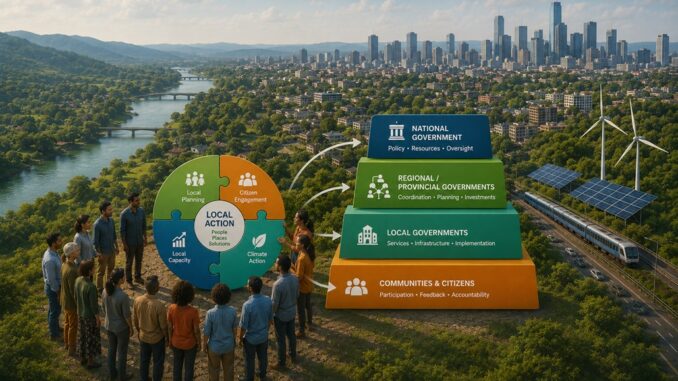
The distinction between localizing development and strengthening multilevel governance is therefore an important one. Localizing development seeks to improve development outcomes by strengthening local institutions and promoting locally responsive implementation. Strengthening multilevel governance seeks to ensure that the entire public sector is organized in a way that enables national, regional, and local governments to work together effectively, with each level exercising meaningful authority within its respective sphere of responsibility.
This distinction is particularly relevant for current discussions around SDG implementation and climate action. Global estimates frequently suggest that a large share of the SDGs is “local” or that local governments are responsible for much of public infrastructure investment needed to achieve sustainable development. While these observations are broadly correct at the global level, they often mask considerable variation across regions and countries. In many countries in Africa and Asia, in particular, local governments continue to exercise only limited authority over many of the sectors that are central to achieving the SDGs, sustainable urban development, and local climate adaptation. And to the extent that local governance institutions are assigned functional responsibilities in these areas, their political, administrative and fiscal authority and autonomy tend to be much more limited compared to their counterparts in OECD countries. Expectations for local implementation therefore need to be matched by equally serious efforts to ensure that local governments possess the powers and resources needed to fulfill those expectations.
Multilevel governance reform is ultimately a national political choice
Strengthening multilevel governance is not simply another institutional reform. Fundamentally, it is a political economy choice about how a country organizes its public sector to achieve its long-term development ambitions. Decisions about which level of government is responsible for education, health, infrastructure, climate adaptation, or local economic development—and equally important, decisions about which level of government controls the financial resources, administrative authority, and political discretion needed to carry out these functions—shape the way in which the state interacts with its citizens and delivers public value.
These choices inevitably involve political trade-offs. Empowering regional and local governments requires national governments to reconsider the distribution of authority, responsibilities, and public resources across the public sector. Such reforms may challenge established institutional interests and require new mechanisms for intergovernmental coordination, accountability, and fiscal management. At the same time, countries that seek to accelerate sustainable development, improve public service delivery, strengthen resilience, or promote locally-led climate action increasingly have strong incentives to ensure that their multilevel governance systems are aligned with these national objectives.
Viewed from this perspective, multilevel governance reform should not be seen primarily as a decentralization agenda or as an external development objective. Rather, it is a strategic choice by national governments to organize the public sector in a manner that enables national, regional, and local governments to work together more effectively in pursuit of shared development outcomes. Countries will inevitably make different choices, reflecting their own constitutional traditions, political institutions, and development priorities. Nevertheless, achieving the full potential of localized development ultimately depends on whether countries choose to place effective multilevel governance at the center of their long-term development strategy.
A new frontier for development cooperation
None of this diminishes the importance of investing in local governments. Stronger local institutions remain indispensable for improving public services, strengthening accountability, and promoting more inclusive development. However, achieving sustainable development requires moving beyond a narrow focus on local capacity toward a broader focus on multilevel governance.
For development partners, this means complementing local governance programs with greater attention to the institutions that shape relations across levels of government. Questions of functional assignment, intergovernmental fiscal systems, political, administrative, and fiscal autonomy, sectoral governance arrangements, and intergovernmental coordination deserve a much more central place within development policy and practice than they currently receive.
Engaging with these issues requires a fundamentally different approach—and a fundamentally different skill set—than traditional efforts to support localized development. Rather than focusing primarily on short-term capacity building or individual local institutions, successful multilevel governance reform requires sustained policy engagement that supports national leadership in navigating the political and institutional challenges associated with restructuring the public sector. This engagement must extend to the highest levels of government, where decisions about the distribution of authority, responsibilities, and public resources are ultimately made. Helping countries build more effective multilevel governance systems is therefore a long-term endeavor, requiring central, regional, and local governments, civil society, and development partners to work together to overcome the political economy constraints that often stand in the way of more empowered regional and local governments—and, ultimately, of achieving their long-term development objectives.
The localization agenda has helped shift global attention toward the places where development actually happens. Building on that important achievement, the next phase of international development cooperation should place equal emphasis on strengthening the multilevel governance systems that enable regional and local governments to translate national ambitions into sustainable development outcomes. Only by combining effective local institutions with effective multilevel governance will countries be able to fully realize the promise of the SDGs and other shared development goals.
Download the LPSA Policy Brief:
Jamie Boex. 2026. A new frontier for development cooperation: From localizing development to leveraging multilevel governance. Centreville: Local Public Sector Alliance.
Note: The Feature Image for this blog post was generated using AI.