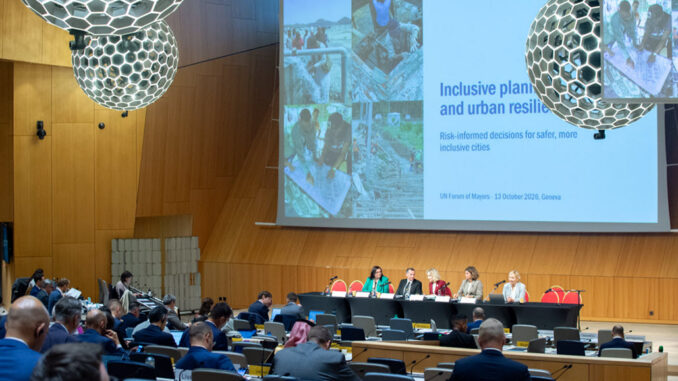
The Sixth United Nations Forum of Mayors, held in Geneva on October 12–13, 2026, brought together city leaders under the theme “Cities delivering for a sustainable future.” The Forum’s outcome document reinforces the growing recognition that cities and local governments are indispensable partners in achieving the Sustainable Development Goals (SDGs). It also signals an encouraging shift toward recognizing that effective local action depends on the broader systems of multilevel governance (MLG) within which cities operate.
The Forum deserves recognition for its efforts to strengthen the voice of local and regional governments in the United Nations system. Its outcome document welcomes steps to expand local government participation in intergovernmental processes and highlights opportunities to bring local perspectives into the 2027 SDG Summit. These developments reflect the increasingly important role of subnational governments in shaping and implementing global development priorities.
Recognizing the importance of multilevel governance
Particularly encouraging is the Forum’s recognition that cities cannot achieve sustainable development outcomes through local action alone. Across its discussions of sustainable mobility, environmental quality, urban resilience, and affordable housing, the outcome document repeatedly acknowledges that local governments require supportive national legal, institutional, and financial frameworks.
For sustainable urban mobility, the Forum explicitly calls for stronger multilevel governance and sustainable financing arrangements. In addressing environmental challenges, it recognizes the importance of predictable financing and fiscal decentralization. Similarly, its recommendations on urban resilience emphasize collaboration across levels of government, while those on affordable housing call for adequate local authority, fiscal resources, and coordinated action.
These are important acknowledgments. They move the discussion beyond strengthening individual municipalities toward recognizing that local development outcomes depend on the organization and effectiveness of the public sector as a whole. There is, however, an important next step. Multilevel governance should not be viewed solely as an enabling condition for inclusive local governance and sustainable local development. Instead, multilevel governance reforms should be recognized an important area of public sector reform in its own right.
From recognizing MLG to reforming MLG systems
The ability of local governments to respond to citizens depends on how responsibilities, authority, administrative capabilities, and financial resources are distributed across national, regional, and local institutions. These arrangements shape which level of government makes decisions, who controls public resources and personnel, and how different levels of government coordinate their actions.
Strengthening local planning, improving municipal management, or expanding opportunities for citizen participation can produce valuable results. But their impact may remain limited when local institutions lack the authority, resources, or discretion needed to act on local priorities. Similarly, calls for greater local financing, while justified, need to be accompanied by more systematic attention to intergovernmental fiscal arrangements, expenditure responsibilities, administrative autonomy, and accountability mechanisms.
This requires moving beyond general appeals for stronger national support to local governments. It means asking how multilevel governance systems themselves can be improved to deliver more inclusive, efficient, responsive, and sustainable public services. There is no single institutional model that works everywhere. Countries differ considerably in their political structures, territorial organization, administrative traditions, and fiscal arrangements. Effective reform therefore requires comparative evidence, country-specific analysis, and sustained dialogue among actors across all levels of government.
Building on the momentum
The growing international recognition of local and regional governments creates an important opportunity to advance this broader agenda. The UN Forum of Mayors, United Cities and Local Governments, Local2030, and other international networks have made valuable contributions to elevating the role of local governments in sustainable development. Their efforts provide a strong foundation for a broader conversation about how national, regional, and local governments can work together more effectively.
However, designing, advocating for, and championing more effective multilevel governance systems requires different policy insights and a broader coalition of actors than required for local government strengthening alone. Beyond local government representatives and municipal practitioners, this agenda must engage national policymakers, ministries of finance and public administration, sector ministries, researchers, development partners, and experts in intergovernmental relations and public finance. It requires examining how political authority, administrative responsibilities, and public resources can be organized more effectively across the entire public sector.
The Sixth UN Forum of Mayors offers welcome evidence that the importance of multilevel governance is gaining recognition. Yet, successful multilevel governance reforms do not happen simply because local governments call for greater authority and resources. Translating the Forum’s key messages into action will require investments not only in further empowering and strengthening local governments themselves, but also in the community of practice that focuses on strengthening multilevel governance systems. It requires building a shared understanding of the shortcomings of existing governance arrangements, developing evidence-based reform options, and bringing together national and subnational policymakers, public finance and governance experts, and development partners to build the political and institutional support needed for meaningful change.
Cities cannot deliver sustainable development alone. Empowering them requires not only stronger local institutions, but also better-functioning multilevel governance systems.
This blog post was authored by Jamie Boex, Executive Director of the Local Public Sector Alliance (LPSA). October 20, 2026.
Feature image: Sixth UN Forum of Mayors, Geneva, Switzerland, October 13, 2026: UNECE / Flickr.