The Role of Youth in Multi-Level Governance: How Can We Meaningfully Engage Young People?
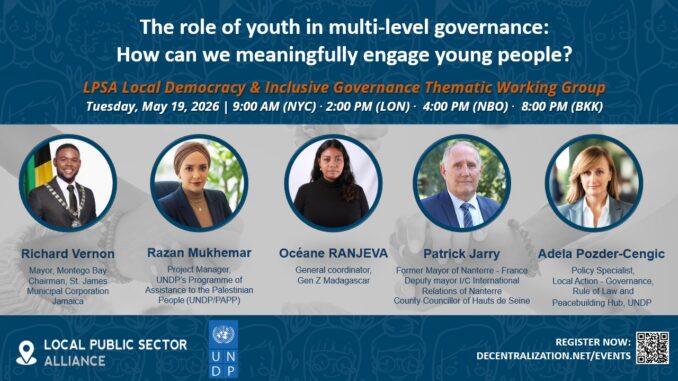
The LPSA Thematic Working Group on Local Democracy and Inclusive Governance convened an open meeting on 19 May to examine the role of youth in multi-level governance and consider how young people can be meaningfully engaged in governance and decision-making processes.
Moderated by Adela Pozder-Cengic of UNDP, the meeting brought together local government leaders, youth representatives and development practitioners from Jamaica, Madagascar, France and Palestine. Michelle Nielsen delivered opening remarks on behalf of UNDP and as Co-Chair of the LPSA Working Group.
Jamie Boex, Executive Director of the Local Public Sector Alliance introduced LPSA as a global community focused on decentralization, localization and multilevel governance. He stressed that inclusive governance and sustainable development require responsive multilevel systems, empowered communities and accountable local officials. Young people’s frustration reflects a wider failure of governments to respond meaningfully to citizens. Because many issues affecting youth are experienced locally, empowered local governments are essential. Meaningful youth participation must extend beyond consultation to actual decision-making roles. Boex also highlighted the lack of global data on youth representation in local governance. Existing ideas require stronger political commitment, institutional follow-through and genuine empowerment to create responsive, participatory and accountable governance.
Razan Mukhemar, Project Manager with the UNDP Programme of Assistance to the Palestinian People emphasized that strong institutions need the trust of young people. In Palestine, the political split, prolonged absence of national elections, war in Gaza and wider political crisis have deepened youth disillusionment. Many young people hear about human rights, participation and accountability without seeing these principles reflected in their lives. The challenge is to move youth from presence to influence.
She described a “stairway approach” to democratic behavioural change, gradually building participation through schools, universities, student councils and youth-serving organisations before progressing to local governance, political structures and national democratic processes. A pilot supporting student council elections in 70 public secondary schools achieved voter turnout above 92 per cent, demonstrating young people’s willingness to participate.
Mukhemar also presented Palestine’s Youth Serving Organizations Coalition, a structured platform for policy dialogue and advocacy. The coalition successfully proposed reducing the candidacy age in the amended local elections law from 25 to 23. Its influence was enabled by a credible platform, structured access to decision-makers, collective action and continuous follow-up. She concluded with three priorities: unite fragmented youth voices immediately; connect young people to an existing governance process in the medium term; and pursue long-term change in how institutions view and include youth in decisions.
Richard Vernon, Mayor of Montego Bay and Chairman of the St. James Municipal Corporation in Jamaica reflected on being elected as a council member at 26, becoming Deputy Mayor four years later and Mayor at 34. Although young people may be trusted through elections, they are not always immediately trusted to make critical decisions. Nevertheless, their voices must be included across all levels of government. Local government is particularly important because it addresses immediate issues such as roads, waste management, public health, water, housing and early childhood education.
In Montego Bay, young people participate through council meetings, committees, junior councils, debates and youth parliamentarian structures. Their practical involvement has demonstrated innovation and an ability to interpret long-standing traditions in ways that strengthen resilience. Through the Bloomberg Youth Climate Action Fund, the Mayor’s Office funded youth-led projects. During Hurricane Melissa, water-harvesting systems supplied more than 2,000 people, while a solar-powered community centre provided energy to nurses serving a nearby hospital.
Vernon stressed that youth participation must be purposeful. Young people should lead projects, receive funding and have their recommendations considered and implemented. When authorities fail to respond, young people lose trust in the political system. Trust and participation grow through results, timely action and succession planning. Policies must reflect empathy for youth, while young people must research and gather facts to participate meaningfully.
Patrick Jarry, former Mayor of Nanterre, Deputy Mayor for International Relations and Country Councillor for Hauts-de-Seine, France, reflected on his experience as a municipal councillor and mayor, explaining that institutions need renewal and that young people bring enthusiasm, creativity and an understanding of the world they will inherit. He warned that ignoring young people’s voices can create risks, particularly in France, where youth revolts and social movements have occurred. While electoral participation remains marginal, youth engagement is taking different forms through spontaneous mobilisation, one-off initiatives, local collective action and digital spaces.
Nanterre has sought to amplify young people’s voices through associations, music, theatre and sport, while recognising that youth are not a single coherent group. Their social circumstances and political views differ, although many carry ideas rooted in democracy and freedom. Jarry described Nanterre’s participatory youth budget, which covers capital investment and operating expenditure, and dedicated youth spaces addressing health and social issues. He stressed that institutions must listen immediately and respond to what young people actually request, helping build trust between youth and local institutions.
Nanterre also established a fund and team to support young residents’ individual or collective projects through implementation, including assistance with financing. In return, participants undertake solidarity activities benefiting residents. Projects may involve culture, sport, training, business creation or solidarity.
Océane Ranjeva, General Coordinator of Gen Z Madagascar described Gen Z Madagascar as a political space of expression rather than a formal entity or organisation. Although the movement has many branches with differing views, it reflects an emerging youth focus. As the first generation to grow up with the internet, young people have extensive access to information and awareness of developments worldwide. They consequently demand rapid change, creating tensions with older systems and generations of government.
She stressed that youth already represent part of the population at every level where public policies are decided. Participatory democracy therefore requires representation and inclusion across different mindsets, social classes and geographic locations. Gen Z Madagascar includes Malagasy youth from around the world, including the diaspora, and from different backgrounds and levels of resources. Youth conditions, traditions and habits also vary considerably between countries.
Attempts by politicians to create their own Gen Z branches were viewed positively because they demonstrated young people’s desire to act, even when they lacked guidance or direction. Political leaders must recognise this diversity and integrate people who think differently rather than treating them as opposition. The movement seeks youth representation in government and consultation before policies are finalised or announced. Meaningful inclusion depends on political conviction and a willingness to include capable young people in discussions, helping them develop critical thinking, identify mechanisms for action and build a longer-term vision.
During the Q&A session, several critical issues were raised by participants. Hanin Elhamdi (Libya, Youth Empowerment Project Manager) described supporting the Ministry of Youth’s forthcoming national youth strategic plan, highlighting safe spaces such as the Tripoli Business Hub, deliberately inclusive consultations spanning Libya’s East-West political divide, gender, and youth with disabilities, and the use of virtual dialogues and gamification to link municipal officials, ministry teams, and UN agencies with young people. John Coonrod reflected that the discussion exposed his own uncertainty about youth engagement policy in Washington, D.C., and committed to investigating it and raising the panel’s insights with city officials, citing frustration among youth there over jobs and crime. Hussein Gahnug (Somalia, Ardaga) described a community-led civic network in Jubaland/Kismayo that has run over 100 civic dialogues and a “Hodan-Bile” government-civil society leadership model, including recent fellowships with the Ministry of Interior.
The meeting concluded with reflections from Michelle Nielsen, who highlighted several key messages from the discussion. Drawing on Razan Mukhemar’s contribution, she emphasized the need to move “from youth presence to youth influence” by progressing beyond participation and giving young people meaningful power within governance processes. She also noted that starting small and focusing on one policy or action at a time can provide a practical pathway towards change. Reflecting on the contributions of Richard Vernon and Patrick Jarry, Nielsen underscored the importance of allocating real resources that enable young people to implement their projects and ideas. She also drew attention to Océane Ranjeva’s question of how trust between young people and institutions can be rebuilt. Reiterating Vernon’s message, she stressed that institutions must not only listen to young people but also act visibly on what they hear, demonstrating that young people’s views are genuinely being considered.
We welcome your reflections and continued engagement as we work together towards more inclusive and resilient communities.
Reminder: You can join any LPSA Expert Working Group free of cost and receive meeting reminders and updates by opting into one or more working groups through LPSA Membership registration.
If you have updates about decentralization or local governance reforms in your country, new research, or local government projects that you would like mentioned during an open meeting, please email the Working Group co-chairs at asia@decentralization.net. A brief announcement may be included at the beginning of the meeting.