As climate change increasingly threatens livelihoods, infrastructure, and public services across East Africa, the need for effective climate adaptation has become more urgent. Yet despite growing international commitments to climate finance, relatively little funding reaches local governments and communities with meaningful authority to decide how these resources should be used.
A new working paper by the Danish Institute for International Studies (DIIS), Modalities for Upscaling Locally Led Climate Adaptation in East Africa (2026), examines how Kenya, Tanzania, and Uganda are addressing this challenge. The study explores the institutional arrangements through which adaptation finance is delivered and considers how locally led adaptation can be scaled up through existing systems of decentralized governance.
Its central message is that locally led climate adaptation is not simply a question of climate finance, but that it is fundamentally a question of effective multilevel governance and finance.
How locally led is climate adaptation finance?
Locally led adaptation (LLA) is based on the principle that communities and local institutions should have meaningful authority over adaptation priorities, investments, and implementation. Because climate risks vary considerably across territories, effective responses require local knowledge, citizen participation, and the ability to tailor interventions to local circumstances. However, the study finds a substantial gap between these principles and how adaptation finance is actually delivered.
Drawing on OECD Development Assistance Committee data for 2015–2022, the study distinguish four governance modalities for adaptation finance: fully centralized projects; deconcentrated sector programs managed by central ministries; partially devolved programs providing some local investment discretion; and fully devolved programs combining climate-informed participatory planning with discretionary local financing.
The analysis finds that approximately one-quarter of adaptation finance is delivered through fully centralized projects. Much of the remainder flows through sector programs in which local governments primarily implement centrally determined priorities, or through partially devolved development programs. Only a small proportion qualifies as fully devolved, locally led adaptation finance: approximately 5% in Kenya and less than 1% in Tanzania and Uganda.
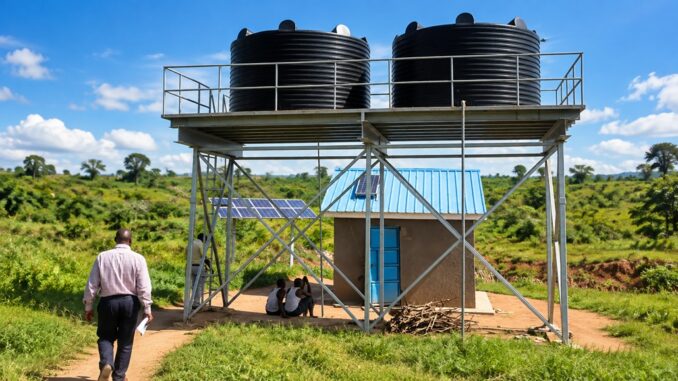
These findings highlight an important distinction. Climate investments may take place locally without being locally led. Building a water system, improving drainage, or supporting climate-resilient agriculture within a local jurisdiction does not necessarily mean that local governments and communities have meaningful influence over investment priorities.
Different decentralization systems, different opportunities
Although Kenya, Uganda, and Tanzania all recognize the importance of local governments in climate adaptation, their decentralization systems provide very different institutional foundations.
Kenya has the strongest framework for devolved climate governance. Its 2010 Constitution established county governments with substantial functional responsibilities and fiscal discretion. Climate legislation further requires counties to incorporate climate considerations into development planning and establish climate governance mechanisms. This provides a relatively favorable environment for integrating adaptation into county planning and budgeting.
Uganda has a long-established system of elected local governments and comparatively strong bottom-up participatory planning arrangements. However, local governments remain highly dependent on conditional intergovernmental transfers, leaving them with limited discretion to allocate resources according to locally identified climate priorities. Tanzania has an extensive system of local government planning and community participation, including its Opportunities and Obstacles to Development (O&OD) methodology. Nevertheless, limited local fiscal autonomy, centralized sector financing, and the recentralization of certain functions constrain the ability of local governments to respond independently to climate risks.
The comparison demonstrates that local participation, legal authority, and fiscal discretion are distinct but complementary dimensions of locally led adaptation. Participatory planning alone is insufficient if local governments lack the resources or authority to act on community priorities.
Building on existing systems: FLLoCA, LoCAL, and SCALE
The working paper examines three important approaches to scaling up locally led adaptation: Kenya’s Financing Locally Led Climate Action (FLLoCA) program, the Local Climate Adaptive Living Facility (LoCAL), and Tanzania’s Sustainable Climate Adaptation for Local Governments and Communities (SCALE) program.
Although their institutional arrangements differ, these initiatives share an important characteristic: they seek to channel climate adaptation resources through established intergovernmental fiscal transfer and local government planning systems, rather than relying exclusively on stand-alone donor projects.
Kenya’s FLLoCA program, with approximately US$300 million in financing, operates across all 47 counties. It combines climate-related fiscal transfers with requirements for climate-risk assessments, participatory planning, and institutional strengthening. LoCAL and SCALE similarly seek to provide local governments with resources and incentives to integrate climate resilience into their planning and investment decisions.
Lessons from three decades of performance-based grants
One of the study’s important contributions is its recognition that locally led adaptation builds on a longer history of decentralization reforms, community-driven development, and performance-based grants. East African countries have nearly three decades of experience using performance-based intergovernmental fiscal transfers to strengthen local government capacity and accountability. Beginning with Uganda’s District Development Programme in the 1990s, similar approaches were subsequently introduced and expanded in Tanzania and Kenya.
Performance-based grants typically combine formula-based allocations, local discretion over eligible investments, institutional performance assessments, and capacity-building support. They seek to strengthen local government systems while creating incentives for improvements in planning, financial management, and service delivery.
This experience offers valuable lessons for climate adaptation programs. Performance incentives need to remain credible and transparent, rather than becoming routine compliance exercises. Assessment systems should avoid excessive administrative complexity, while maintaining sufficient safeguards for public financial management and accountability. Local governments also need predictable resources and meaningful investment discretion if performance incentives are to translate into better outcomes.
Importantly, climate adaptation programs should learn from existing grant systems rather than create parallel planning, financing, and reporting arrangements that fragment local governance.
From climate projects to climate-responsive local governance
The experience of Kenya, Uganda, and Tanzania suggests that scaling up locally led adaptation requires more than increasing the flow of climate finance to local communities. It requires strengthening the local government institutions through which adaptation investments are planned, financed, and implemented. Rather than creating parallel climate financing mechanisms, governments and development partners should seek to integrate climate resilience into existing systems of intergovernmental finance, participatory planning, and local service delivery. Ultimately, the success of locally led adaptation should be judged not by the number of projects financed, but by whether it enables communities and local governments to make better adaptation decisions and achieve more resilient outcomes.
Read the complete study: Friis-Hansen, E., and Tidemand, P. J. (2026). Modalities for Upscaling Locally Led Climate Adaptation in East Africa. DIIS Working Paper 2026:06. Danish Institute for International Studies.
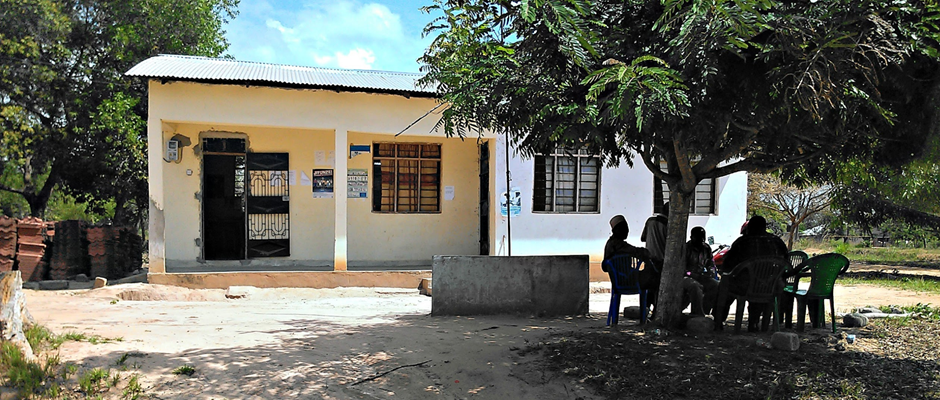
Feature image: A local, but sector ministry managed project in Sembabule District, Uganda. January 2019. Photo: Per Jakob Tidemand