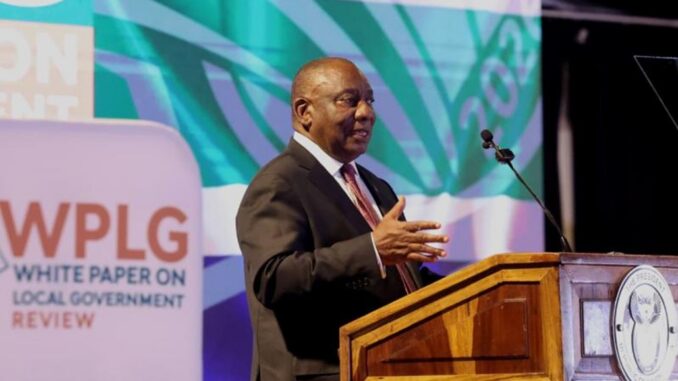
Nearly three decades after South Africa adopted its landmark 1998 White Paper on Local Government, the country has embarked on a major overhaul of its local governance system. On October 22, 2026, President Cyril Ramaphosa officially launched the Revised White Paper on Local Government, following its approval by Cabinet on September 23. The new policy framework seeks to address persistent weaknesses in municipal governance, financial sustainability, institutional capacity, and service delivery, while reaffirming the constitutional foundations of democratic local government.
The launch, held under the theme “Every Municipality Must Work: From Policy to Collective Action,” marks an important milestone in South Africa’s efforts to renew a local government system that has struggled to fulfill the developmental ambitions of the post-apartheid era.
From consultation to a new reform agenda
The revised White Paper is the culmination of an extensive policy review led by the Department of Cooperative Governance and Traditional Affairs (CoGTA). Initiated following a Cabinet decision in 2022, the process included commissioned research, stakeholder consultations, and two rounds of public submissions. An initial discussion document was released in April 2025, followed by a draft White Paper for public comment in May 2026.
As Decentralization.Net reported in March 2026, the review represented a potentially important inflection point for South African local government. Rather than simply proposing another municipal support program, the process invited a broader reconsideration of the institutional, political, and fiscal arrangements underpinning the country’s system of developmental local government.
CoGTA made considerable efforts to solicit input from across government, organized local government, academia, civil society, professional bodies, and other stakeholders. The process attracted 266 submissions during its first public consultation phase and another 170 submissions on the draft White Paper. The final document reflects this engagement, while acknowledging that some difficult policy choices remain contested.
What does the new White Paper entail?
The nearly 200-page White Paper presents a comprehensive reform agenda spanning municipal institutions, intergovernmental relations, political accountability, public administration, municipal finance, infrastructure, and citizen engagement. Several proposed changes are particularly significant.
First, the White Paper proposes a more differentiated approach to municipal structures, powers, and functions. South Africa’s current system combines single-tier metropolitan municipalities with a two-tier arrangement of district and local municipalities elsewhere. The White Paper recognizes that this arrangement does not always reflect local conditions or institutional capacity. It proposes expanding the use of single-tier municipalities where appropriate, while retaining and strengthening district municipalities where their coordinating, support, or regional service delivery roles add value. Over time, this could lead to a substantially simplified local government structure.
Second, the White Paper seeks to strengthen municipal accountability and professional administration. Political interference, weak enforcement, corruption, and inadequate administrative capacity have undermined municipal performance. The proposed reforms emphasize merit-based appointments, clearer boundaries between political leadership and municipal administration, stronger oversight, and more consistent consequences for misconduct and noncompliance.
Third, municipal finance is placed at the center of the reform agenda. Many municipalities face structural revenue constraints, mounting debt, poor collection rates, and deteriorating infrastructure. The White Paper calls for an interim municipal financial and service delivery stabilization package, alongside a more fundamental review of the local government fiscal framework. The objective is to better align municipal responsibilities with revenue instruments, intergovernmental transfers, and financing arrangements, while recognizing differences in local fiscal capacity and expenditure needs.
Fourth, the White Paper seeks to improve the reliability of basic services and municipal infrastructure. It distinguishes between municipal authority over a service and the arrangements through which that service is delivered. This creates opportunities for shared services, regional utilities, and other public or private service providers, while retaining appropriate public accountability. Greater attention is also given to infrastructure maintenance, asset management, and the financial sustainability of municipal services.
Underlying these proposals is a broader recognition that municipal performance cannot be improved by focusing on municipalities alone. National and provincial governments also shape local outcomes through their regulatory, financing, oversight, and support responsibilities. The White Paper therefore calls for stronger intergovernmental coordination and mutual accountability across all three spheres of government.
From policy reform to implementation: dedicated transition management
Perhaps the most important feature of the revised White Paper is its emphasis on implementation. South Africa has no shortage of policy frameworks, legislation, or diagnoses of municipal dysfunction. The challenge has been translating these into sustained institutional improvements and reliable public services.
To address this, Cabinet has endorsed the establishment of a time-bound Local Government Transition Management Body and a coordinated implementation program involving CoGTA, the Presidency, and National Treasury. A Local Government Transition Plan is intended to identify responsibilities, sequence reforms, monitor progress, and coordinate immediate stabilization measures with longer-term institutional and fiscal changes.
Some reforms can proceed within the existing constitutional and legislative framework. Others, particularly those affecting municipal structures and the allocation of powers and functions, may require legislative or constitutional amendments.
The stakes are considerable. South Africa’s 257 municipalities remain central to the country’s democratic and developmental aspirations, but persistent service delivery failures and financial distress have eroded public confidence in local institutions. The new White Paper offers an ambitious framework for addressing these challenges without abandoning the constitutional commitment to decentralized, democratic local government.
Whether this becomes a genuine turning point will depend less on the ambition of the policy document than on the political commitment, institutional coordination, financial resources, and sustained accountability brought to its implementation.
For South Africa, the next phase of local government reform has now begun.
Read more: