South Africa’s system of local government is at a critical juncture. Nearly three decades after the advent of democratic local governance, the country has built a comprehensive municipal system and expanded access to basic services. Yet in many municipalities, service delivery breakdowns, governance failures, and financial distress have eroded public trust. The current review of the White Paper on Local Government is therefore more than a policy update—it is a reconsideration of the framework that defines what municipalities are meant to do, and how the intergovernmental system supports them.
The legacy of the 1998 White Paper
South Africa’s foundational 1998 White Paper on Local Government gave practical meaning to the Constitution’s recognition of local government as an autonomous sphere. It introduced the concept of “developmental local government”—municipalities working with communities to advance social and economic development while delivering basic services.
The framework emphasized four pillars of “developmental local government”: promoting growth and development; integrating and coordinating local actors; deepening democratic participation; and fostering capable, learning institutions. These principles shaped the subsequent legal framework–including Municipal Systems Act, Municipal Structures Act, and the Municipal Finance Management Act–as well as the broader architecture of post-apartheid local governance in the country.
Why review now?
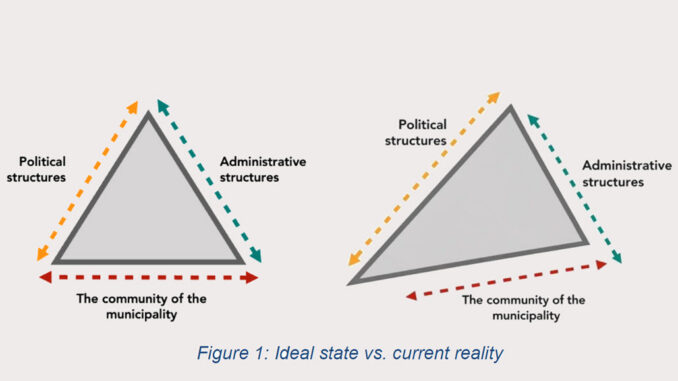
Despite this ambitious vision, performance has diverged sharply across municipalities. The current review process acknowledges that many failures are not merely operational, but systemic—rooted in intergovernmental design, fiscal stress, capacity gaps, and weak accountability mechanisms.
The review follows the 2022 Presidential Local Government Summit, the formal introduction of the review in Parliament in 2024, and a 2025 discussion process. The intention is to finalize a new White Paper in 2026 after broad consultation.
What the revised draft seeks to address
The consultation draft of the Revised Draft White Paper contains 65 reform recommendations across a wide range of thematic areas, including institutional professionalism, political leadership, intergovernmental coordination, financial sustainability, citizen participation, service delivery, and the role of traditional leadership.
The draft stresses cooperative governance, improved transparency and citizen engagement, and structural reforms to make local government more capable and responsive. Although the review retains the spirit of developmental local government, its emphasis on stronger oversight, standardization, and coordination across spheres (including potential amendments to existing legislation) leans toward more structured central oversight and coordination as a requirement to stabilize and empower municipalities.
Why this engagement matters
The convening of a broad stakeholder consultation by Minister Velenkosini Hlabisa of Cooperative Governance and Traditional Affairs (CoGTA)—under the theme “Every Municipality Must Work: A Call to Collective Action”—signals an attempt to build shared ownership of the proposed reforms. By bringing together political parties, business, civil society, traditional leaders, and other constituencies, the process aims to ground reform in democratic participation and collective accountability.
The ultimate test will be whether the revised White Paper translates ambition into implementation: clarifying roles across spheres, strengthening oversight and support, and ensuring that institutional design matches the diversity of South Africa’s municipalities.
If successful, the review could renew the developmental local government vision for a new era—reframing it not only as a constitutional ideal, but as a practical commitment that every municipality must, indeed, work.
Read more: Minister Hlabisa convenes the broad stakeholder engagement on the Revised Draft White Paper on Local Government (Ministry of Cooperative Governance and Traditional Affairs)