
Local governments are under growing pressure to deliver increasingly complex services with constrained financial and administrative resources. Demographic ageing and population decline are reshaping demand in many territories, while urban growth is creating new pressures on transport, housing, land use and infrastructure. At the same time, challenges such as climate transition, digitalization, and territorial competitiveness increasingly extend beyond municipal boundaries.
The scale of the challenge is significant. Across the OECD, around 38% of municipalities have fewer than 5,000 inhabitants, while 25% have fewer than 2,000. Small size can constrain administrative capacity, service delivery, and investment planning, particularly where municipalities struggle to recruit specialized staff or achieve economies of scale. Yet fragmentation is not only a problem for small municipalities. Even larger local governments can face difficulties when the geography of service demand, economic activity or environmental systems extends beyond their administrative boundaries.
Against this backdrop, the recent OECD report How to Make Inter-Municipal Cooperation Work makes an important point: inter-municipal cooperation (IMC) is not a substitute for other territorial reforms, but it is a particularly pragmatic and flexible instrument. It allows municipalities to pool resources, share expertise and organize services at a scale closer to functional realities, while preserving municipal autonomy and identity. The policy question, therefore, is no longer simply whether municipalities should cooperate, but under what conditions cooperation actually delivers better public value.
Why inter-municipal cooperation?
The OECD identifies several structural drivers behind the growing relevance of IMC: municipal fragmentation, limited administrative capacity, demographic change, fiscal pressures, increasing service complexity and the persistent mismatch between administrative borders and functional territories.
Demographic change is particularly important. Ageing, outmigration and population decline can erode the economies of scale on which local services and infrastructure depend. Cooperation can allow municipalities to pool staff and infrastructure, reorganize service networks and maintain access to essential services. The same logic applies to growing urban and metropolitan areas. Transport, housing, spatial planning, waste management and environmental protection frequently generate cross-boundary effects. Cooperation can reduce fragmentation and help address situations in which central municipalities bear the costs of services used by a wider metropolitan population.
But the potential benefits extend beyond cost savings. Municipalities can use cooperation to access specialized expertise in areas such as procurement, financial management, IT, planning and legal services; achieve economies of scale in network and capital-intensive services; strengthen their capacity to prepare and finance investments; and improve strategic coordination across functional territories. In this sense, the strongest argument for inter-municipal cooperation is not simply doing the same things more cheaply. It is enabling municipalities to do things that they cannot effectively do alone.
Cooperation is not automatically efficient
At the same time, creating a cooperative arrangement does not automatically improve local governance. Poorly designed arrangements can create additional administrative layers, overlapping responsibilities and higher coordination costs. Governance and accountability can also become more complicated. Responsibilities may become blurred when decisions move from directly elected municipal councils to jointly governed bodies. Larger municipalities may exercise greater bargaining power, while smaller jurisdictions may fear losing control over priorities or bearing disproportionate costs.
The fiscal risks are equally real. Cooperative arrangements can suffer from unfunded mandates, free-riding, common-pool problems and disputes over cost sharing. And empirical evidence on their effectiveness remains context-dependent: efficiency gains appear more consistently in technical and capital-intensive services and among smaller municipalities, but outcomes vary considerably by function, scale, governance arrangements and transaction costs. The implication is that success should be judged by the public value created, not by the existence of a cooperative structure itself.
How to make inter-municipal cooperation work
The OECD identifies three mutually reinforcing pillars for an effective IMC policy framework: legal, institutional and fiscal. These formal foundations need to be supported by enabling conditions including trust, balanced governance, transparency, accountability, citizen engagement, reliable data and monitoring.
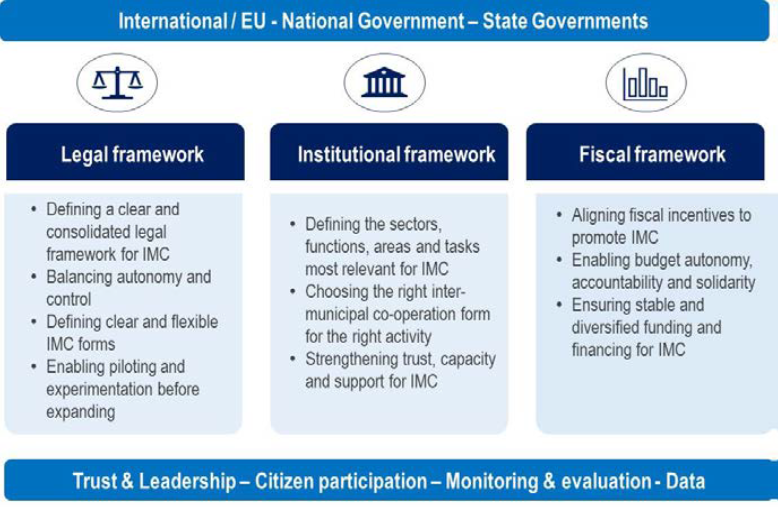
A clear but flexible legal framework. Municipalities need legal certainty about what they are permitted to do, how responsibilities can be delegated, how joint entities can be created and governed, and how arrangements can be modified or terminated. The OECD argues against pursuing extremes: legislation should neither be so rigid that it prevents adaptation nor so vague that municipalities face uncertainty. Effective systems provide different options, ranging from relatively simple contractual arrangements and shared services to more institutionalized entities.
Legal frameworks should therefore clarify the available forms of cooperation, delegation of competences, governance and representation, financial responsibilities, accountability and oversight, dispute resolution, and rules for withdrawal or dissolution. They should also leave room for experimentation. Pilot initiatives can allow municipalities to test different forms of cooperation before scaling them up and generate practical evidence about what works in different territorial and institutional settings.
Institutions aligned with functions and territories. Legal permission to cooperate is not enough. Institutional design must reflect what is being delivered, at what scale and by whom. Different services have different functional geographies. Public transport may require organization at a metropolitan or labor-market scale, while waste collection or road maintenance may be more efficiently organized among a smaller group of municipalities. A single cooperation structure will therefore rarely be optimal for every function.
The starting point should be the function, not the institution. Policymakers should ask: What is the functional geography of the service? What scale is required to achieve efficiency and quality? Which responsibilities need to be shared or delegated? And what degree of institutionalization is justified?
For operational services, contracts or shared-service arrangements may be sufficient. More complex and long-term functions may require dedicated governance, staffing and financing mechanisms. Higher levels of government also have an important role in providing policy direction, technical assistance, incentives and platforms for knowledge exchange. But such support should enable locally appropriate cooperation rather than impose uniform institutional structures.
A sustainable fiscal framework. Inter-municipal arrangements also need predictable resources. The report recommends removing fiscal disincentives that penalize municipalities for pooling responsibilities and using targeted incentives to help cover the initial transaction, coordination and investment costs of cooperation. Temporary incentives, however, are not enough. Sustainable arrangements may combine municipal contributions, intergovernmental transfers, own-source revenues and, where appropriate, borrowing or other financing mechanisms.
Cost-sharing arrangements are particularly important. Contributions might reflect population, service usage, fiscal capacity or combinations of these factors. Whatever formula is used should be transparent and supported by reliable information on costs and utilization. Fiscal solidarity mechanisms may also be necessary where municipal capacities differ substantially or where core municipalities bear disproportionate costs for services benefiting a wider population. For capital-intensive cooperation, access to borrowing can be transformative. But it also makes clear rules on liabilities, repayment responsibilities, fiscal oversight and financial accountability especially important.
What can countries learn from each other?
There is no single model for successful inter-municipal cooperation. The OECD report includes country snapshots covering 44 OECD and accession countries, showing considerable variation in legal, institutional and fiscal arrangements. The comparative evidence is useful precisely because it does not point toward a universal “best model.”
Countries combine voluntary and mandatory approaches, contractual arrangements, shared services and institutionalized entities in different ways depending on their territorial organization, municipal structures, legal traditions and intergovernmental systems. The lesson is therefore not to copy a particular institutional model, but to understand the conditions under which different approaches work and adapt them to national and territorial circumstances.
From cooperation as an option to cooperation as a governance capability
The OECD report’s central message is more nuanced than simply calling on municipalities to “work together.” The objective is not to create more inter-municipal bodies, nor should cooperation primarily be viewed as a mechanism for reducing municipal expenditure. The objective is to match the scale of governance with the scale of the problem.
For shrinking municipalities, this may mean pooling staff, maintaining essential services and rationalising infrastructure. For growing metropolitan areas, it may mean coordinating transport, land use and investment. For both, it can mean gaining access to expertise, financing and technical capacity that would otherwise remain out of reach.
Inter-municipal cooperation should therefore not be viewed merely as a temporary or second-best response to municipal fragmentation. Properly designed, it is itself a form of territorial governance—one capable of combining scale with proximity, capacity with autonomy, and efficiency with territorial solidarity.
As demographic, fiscal and policy pressures continue to reshape local government, perhaps the most useful question is no longer simply how large should a municipality be? Instead, we should ask: At what scale should a particular public function be governed—and how can municipalities organize themselves to operate effectively at that scale?
Read full report here:
OECD (2026), How to Make Inter-Municipal Co-operation Work, OECD Multi-level Governance Studies, OECD Publishing, Paris, https://doi.org/10.1787/44d03db6-en.