
In places affected by conflict and social divisions, the way governments organize and finance local services across different levels can either reinforce divisions or help communities work together. Intergovernmental systems are therefore about more than efficiently dividing responsibilities and money across levels of government: when designed well, they can create incentives for participation, cooperation, and collective problem-solving at the local level.
Competition over scarce public resources is usually assumed to breed conflict, especially in divided communities. But a recent study of Indonesia’s largest community-driven development program (published recently in AEJ: Applied Economics) suggests that the opposite can also be true: making villages compete against each other for government funding reduced violent conflict within those villages. The finding matters for decentralization and local development because competitive mechanisms are widely used to allocate grants and other public resources across local governments and communities—yet we know relatively little about how the design of these mechanisms affects participation, cooperation, and social cohesion.
The Setting: Indonesia’s Kecamatan Development Program
The Kecamatan Development Program (KDP), launched in late 1998 after the fall of the Suharto regime, was a community-driven development program providing fixed block grants to subdistricts (kecamatans). Villages within each subdistrict competed for a share of that funding by identifying local priorities and preparing proposals for investments such as roads, schools, and health facilities.
Because the grant was fixed regardless of how many villages shared a subdistrict, the number of villages directly set the intensity of competition: more villages meant a smaller chance of winning funding for any one of them. The KDP program design thus created a natural experiment: since the size of the grant was fixed, differences in the number of villages within a subdistrict generated differences in the intensity of competition for funding.
The study’s authors combine official KDP program data with conflict data from the UN Support Facility for Indonesian Recovery, covering 14 Indonesian provinces. They compare conflict across many groups at once: subdistricts with more or fewer villages, in and out of the KDP, before and after it began. This approach helps distinguish the relationship between competition and conflict from broader changes in conflict over time and differences between areas.
Key Findings
1. More competition, less within-village conflict, but only up to a point.
On average, a subdistrict with 11 villages in the KDP experiences 11 percent fewer conflicts than a comparable subdistrict with 10 villages. This reduction occurs only at moderate levels of competition. At higher levels, more villages stop entering the competition altogether, and the conflict-reducing effect disappears.
The figure below shows why. It plots the average number of villages that submit a proposal (participants) against the number that receive funding (winners), by the total number of villages in a subdistrict. Where villages are few, nearly everyone submits and wins: there is relatively little competition. In the middle range, participation stays high but the odds of winning fall with each added village: this is genuine competition. Only at the highest numbers does participation itself fall, as villages increasingly choose not to enter at all.
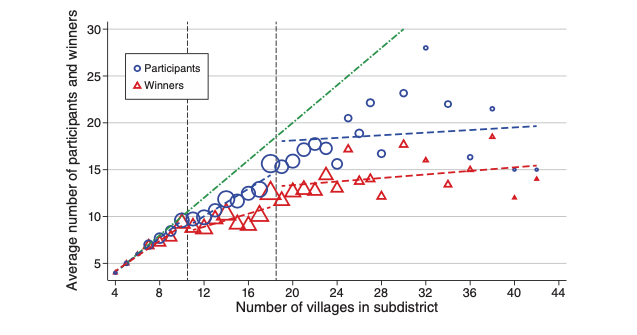
Figure 1 (reproduced from Garg et al. 2026, Figure 2). Numbers of participants and winners by the overall number of villages in the subdistrict.
2. The effect is about participation, not winning.
The reduction in conflict is nearly identical for villages that won funding and villages that submitted proposals but lost, while there is no significant effect among villages that never entered the competition. This suggests that the effect is associated with participation in the competitive process rather than with receiving funding itself.
3. Competition reduces conflict within villages, without increasing conflict between villages.
Despite villages competing directly against their neighbours, the authors find no evidence that competition increased conflict between villages. The conflict-reducing effect is concentrated entirely in reduced within-village violence.
The chart below traces, year by year, the estimated relationship between the number of villages in a subdistrict and conflict, separately for within-village (Panel A) and across-village conflict (Panel B). Before the KDP began, the estimates show parallel pre-trends, indicating no evidence of differential trends between the two groups. After the program starts, within-village conflict declines as competition increases, while across-village conflict shows no comparable movement.
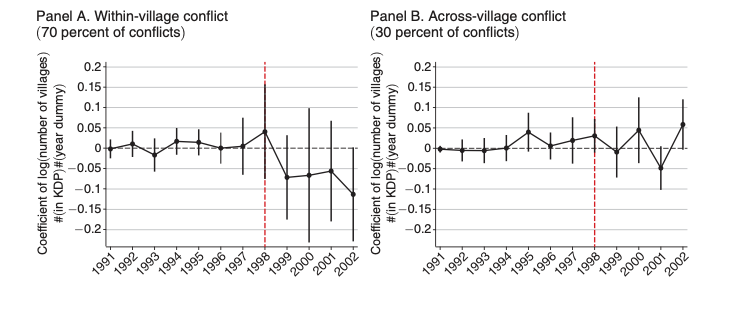
Figure 2 (reproduced from Garg et al. 2026, Figure 4). Event study (triple differences): the impact of competition in the KDP on conflict.
4. The effects are stronger in more ethnically fractionalized villages, alongside greater participation in village meetings.
The effect of competition on conflict is more than twice as large in villages with higher ethnic fractionalization and segregation, though the authors describe this as suggestive rather than statistically significant. The authors also find higher attendance at village meetings in subdistricts facing greater competition, up to moderate levels of competition. Together, these findings are consistent with the authors’ interpretation that competition may encourage greater participation, effort and cooperation within villages.
What this means for decentralization and local governance
The authors offer two explanations. First, competition may shift how villagers see themselves, making village identity matter more than ethnic or religious identity. Second, the incentive to win may encourage villagers to coordinate and work together. Taken together, the findings suggest that moderate competition, combined with civic engagement, can reduce local conflict and violence.
Two caveats are worth flagging. First, the authors themselves note that the study cannot test whether these gains persist once a program ends; they leave long-run persistence an open question for future research, so the study does not establish whether the effect persists over the longer term. Second, the findings come from the specific institutional and social context of Indonesia, so it remains an open question whether similar effects would emerge in other settings.
The implications extend beyond Indonesia. Similar competitive allocation mechanisms are used globally, including India’s Smart Cities Mission, the US RAISE infrastructure grant program, the EU’s Urban Innovative Actions, and the Philippines’ Seal of Good Local Governance. These programmes illustrate that competitive allocation is used in other settings, but the paper does not claim that they would produce the same effects on conflict or social cohesion.
For practitioners working on intergovernmental transfers and competitive grant programs, the study offers an important lesson about the design of competition. In the KDP, moderate competition was associated with lower conflict within villages, while very high levels of competition discouraged some villages from participating and the conflict-reducing effect disappeared. Just as importantly, the effect did not depend on whether villages ultimately won or lost funding. This suggests that the participatory process generated by competition—not simply the allocation of money—may itself have strengthened cooperation within communities.
The KDP experience therefore offers a different perspective on competition for public resources. The study suggests that competition between villages, when combined with civic participation, can be associated with greater cooperation within otherwise divided communities. More broadly, the findings highlight how the design of competitive funding processes may shape not only who receives public resources, but also how communities participate and cooperate in pursuing them. It can also shape how communities organize, participate, and work together.
Read the full paper (may require payment):
Garg, Teevrat, Caterina Gennaioli, Stefania Lovo, and Gregor Singer. 2026. “Fostering Cooperation: The Conflict-Reducing Effects of Intervillage Competition for Government Transfers.” American Economic Journal: Applied Economics 18 (3): 283–321.
An open-access version of the study is available here
Note: The Feature Image for this blog post was generated using AI.