Under the Fourth Schedule of the Constitution (Part II (9)), county governments in Kenya have constitutional functions and powers for “pre-primary education, village polytechnics, homecraft centres and childcare.” Furthermore, the 2010 Constitution of Kenya provides numerous provisions in pursuit of human rights, gender equality, and inclusive governance.
Ongoing policy discussions under the Localizing Women’s Economic Empowerment in Africa (2024-2025) project have revealed two important insights. First, although childcare is explicitly recognized as a function of county governments under Kenya’s devolved system, the actual provision of childcare services has historically been driven largely by civil society actors—including NGOs, community-based organizations, and private providers. Second, childcare emerged as a distinct public service sector only with the advent of devolution, meaning that most county governments are still in the early stages of defining their roles, developing policy frameworks, and investing in service delivery.
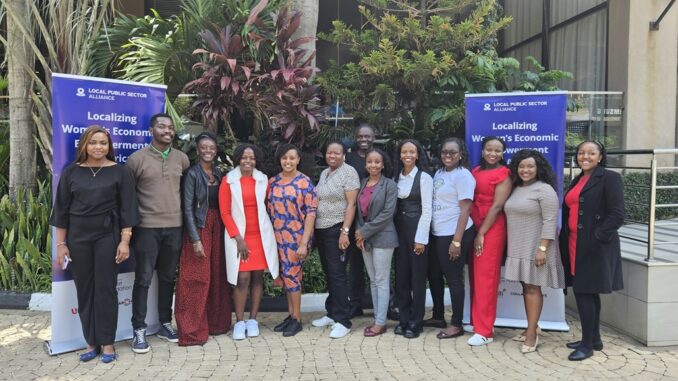
These dynamics formed the backdrop for commissioning a study to better understand better county-level engagement in childcare provision in Kenya. Conducted by Local Public Sector Alliance (LPSA) and the Center for Rights Education and Awareness Kenya (CREAW) with inputs from Localizing WEE in Kenya Technical Working Group partners, the study aimed to inform policy dialogue by providing a record of the current state of county initiatives and programs promoting access to childcare for children under 4 years.
What Childcare Means in This Study
In the context of the current study, childcare refers to the supervision and care of infants and young children up to the age of four, during both daytime and nighttime hours, particularly so that their parents can pursue employment, attend school, or engage in other activities. Childcare facilities may be referred to by different names in Kenya and around the world, including daycare centers, creches, or nursery schools. According to the Kenyan Constitution, childcare facilities fall within the functions and powers of county governments. From the age of four, children in Kenya are eligible to enroll in county-provided Early Childhood Development (ECD) Centers.
Study Scope and Approach
Employing a mixed-methods approach, the current study assessed county-level involvement in childcare provision across six counties: Nairobi, Kisumu, Tharaka Nithi, Kitui, Homa Bay, and Narok. This assessment of county governments’ engagement in the childcare ecosystem focused on five thematic areas:
- General county policy framework for childcare
- County implementation framework for childcare
- County government organizational structure and staffing related to the provision, regulation and/or management of childcare
- County government activities related to regulating and/or licensing of childcare
- County government budget/funding of childcare
The report provides a narrative description of county efforts in providing childcare services in selected counties and assesses county initiatives and programs promoting access to childcare by clarifying the extent to which counties are actually delivering or supporting/funding public or private childcare services using county resources and/or staff, or whether county activities are (largely or completely) limited to facilitating the operation and provision of private childcare services by the private sector, community-based organizations, and/or non-profit organizations.
Key Findings
- Inconsistent policy frameworks: Nairobi, Kisumu, and Tharaka Nithi have made progress in developing legal and policy instruments for childcare, whereas Kitui, Homa Bay, and Narok mainly rely on national guidelines with limited county-specific frameworks. Although the national government provides guidelines for ECDE provision, it does not yet offer standards and norms for childcare facilities or home-based childcare provision to children under four.
- Limited (if any) direct county provision: Kisumu, Homa Bay, Kitui, Nairobi, and Narok counties do not directly operate or fund public childcare centers. Instead, they depend on informal community arrangements or partnerships with NGOs. Only a few counties, such as Tharaka Nithi, have piloted county-supported childcare facilities like the Chuka Market Crèche. Even then, the running and operation of the crèche is not funded or operated by the county itself.
- Weak institutional structures: Dedicated childcare units and staff within county government structures are uncommon. In the six counties, childcare responsibilities are generally integrated into broader ECDE or social services departments, lacking specialized personnel or clear mandates. Only Nairobi County has a dedicated childcare unit.
- Gaps in licensing and regulation: Informal childcare providers are prevalent, especially in urban settlements and rural areas. While some counties, such as Nairobi and Kisumu, have established licensing protocols and enforcement mechanisms, others lack inspection systems or fail to uphold standards. Often, the protocols and minimum standards are too stringent for the existing providers to meet.
- Minimal budget allocations: Childcare for children under three is seldom prioritized in county budgets. While ECDE receives some funding, it usually targets pre-primary learners aged 4–5. Budget lines specific to daycare or nursery care are often absent or included under broader education or social service programs.
Gaps and Emerging Good Practices
Critical gaps identified include the lack of standalone childcare policies in numerous counties, the lack of county investment in childcare facilities for children aged 0–3, the absence of effective regulation of (largely informal) daycare providers, and the absence of childcare benefits for county employees. No counties directly operate or own childcare centers for children under four, provide subsidies or vouchers to families, or contract private enterprises or social enterprises to run childcare facilities. Most counties rely on private, NGO, or community-led initiatives and informal arrangements, with limited to no direct county government financial support or involvement in day-to-day childcare operations for this age group.
Furthermore, many counties lack dedicated childcare units or adequately trained staff to manage these services, hindering efforts to standardize quality and safety throughout the system.
Despite these challenges, some good practices are emerging. Tharaka Nithi’s Chuka Market Crèche—even though a single example—exemplifies how county-driven, locally anchored childcare services can enhance women’s labor participation and improve child welfare outcomes. Similarly, Nairobi’s collaboration with the private sector under the Childcare Facilities Act of 2017 demonstrates movement towards an effective regulatory model. Kisumu’s integration of vocational training and childcare further illustrates the transformative potential of intersectoral approaches.
Recommendations and Way Forward
The report concludes by emphasizing the need for institutional strengthening, capacity building, and targeted investment at the county level. It recommends developing comprehensive county childcare policies, structuring budget lines for children under three, and harmonizing regulatory systems supported by national guidelines.
A coordinated, well-funded, and rights-based childcare system is essential for achieving Kenya’s Vision 2030 and the broader Sustainable Development Goals related to gender equality, decent work, and inclusive growth for all.
The preparation of the document was guided by the Technical Working Group on Localizing Women’s Economic Empowerment and Childcare in Kenya. The Technical Working Group of the Localizing WEE in Africa Project is comprised of a cross-sectoral array of actors, including Wowmom Kenya, Kidogo Early Years, Nurture First, WIEGO, Uthabiti Africa, the Collaborative Action for Childcare, Council of Governors, the National Gender and Equality Commission, CREAW Kenya, Intergovernmental Relations Technical Committee, ICRW, and Strathmore University. Together, these organizations are working towards a common goal-the formalization and improvement of the childcare sector in Kenya.
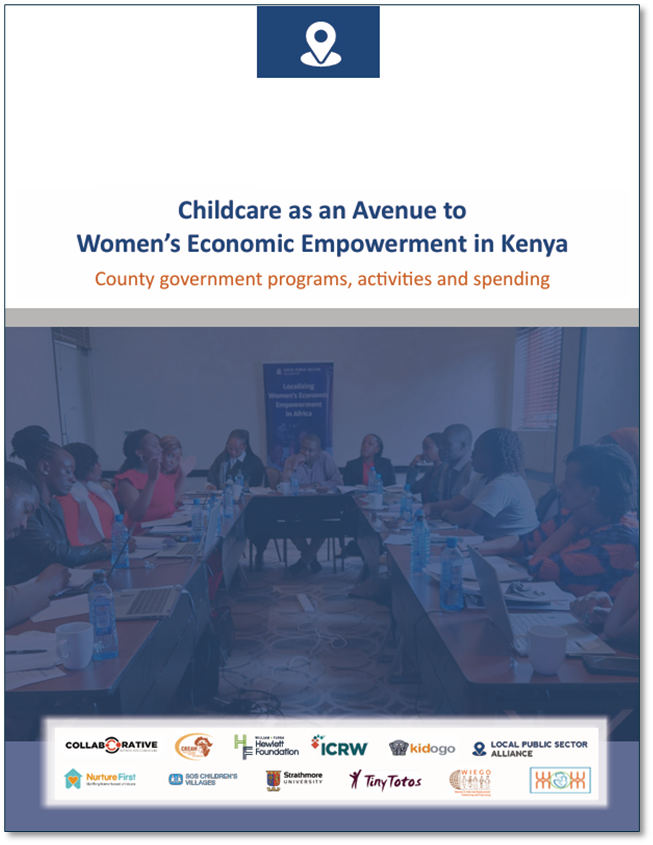
The full report is publicly available:
Local Public Sector Alliance/Center for Rights Education and Awareness Kenya (CREAW). 2025. Childcare as an Avenue to Women’s Economic Empowerment in Kenya: County Government programs, activities and spending. Nairobi, Kenya