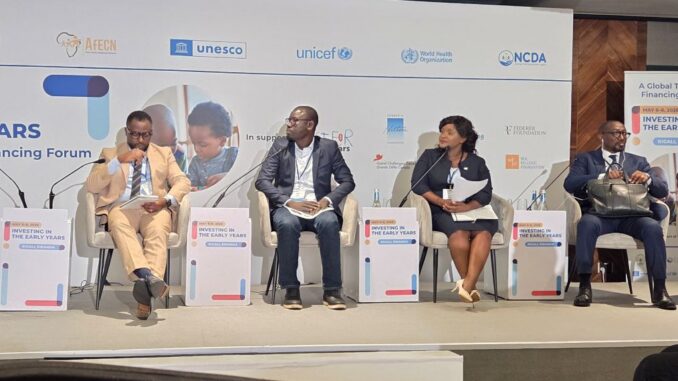
From May 5-8, 2026, early childhood champions from around the world met in Kigali for Investing in the Early Years: A Global Technical Financing Forum, convened by ECDAN with AFECN, UNESCO, UNICEF and WHO. The Local Public Sector Alliance joined the conversation to bring a decentralization and multilevel governance lens to early years financing.
Ms. Jacqueline Muthura, LPSA’s Coordinator for Africa and Gender Equity & Women’s Empowerment, served as a discussant in the session on “Expanding the financing envelope to support key early years policy priorities.” LPSA’s contribution started from a simple but often overlooked observation: the real financing issue is not, first and foremost, a finance problem. It is a political economy problem.
Childcare and ECD in Kenya: fiscal space exists, but politics decides
Drawing on the Localizing Women’s Economic Empowerment and Childcare in Africa project, and on LPSA’s broader work on intergovernmental finance, the discussion highlighted how childcare and early childhood services sit inside a devolved system. In Kenya, both ECDE and childcare are county responsibilities. Counties receive unconditional transfers from the national government through the equitable share and are free to allocate these resources across their constitutionally assigned functions.
LPSA’s fiscal space analysis shows that, once the 2024/25 revenue‑sharing parameters and census data are applied, around KSh 7.39 billion per year is indicatively available across Kenya’s 47 counties for childcare facilities and services – roughly KSh 1,563 per child under four. This amount sits within the “other county services” window of the equitable share formula. It is not ring‑fenced, but it is there to be claimed for young children if the right incentives and accountability mechanisms are in place.
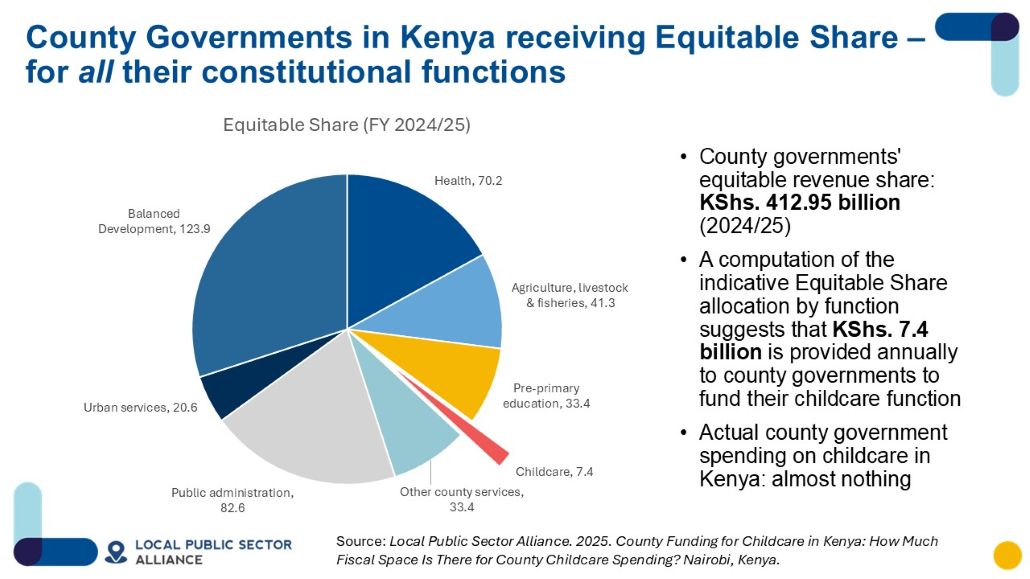
Yet actual county spending on childcare is extremely low, and in most counties childcare does not even appear as a separate program or budget line. The lesson is stark: the problem is not that there is literally no money; the problem is that childcare and early childhood do not yet rise to the top of the political priority list.
The figure below illustrates this trap. For childcare – and much of ECD – many counties are stuck in the bottom‑left corner: low investment and low quality. Everybody agrees that the ambition is to move to the top‑right: higher investment and higher quality.
The early years community often imagines this journey as a red arrow (in the figure below): “if additional funding can be secured, services can be improved and scaled”. Much effort therefore goes into mapping financing gaps and designing new instruments. However, LPSA’s work in Kenya suggests that decision‑makers rarely start from the question “Is childcare underfunded?” Instead, they ask: “Will spending (more) on this service help me demonstrate results to my constituents and get me re‑elected?”
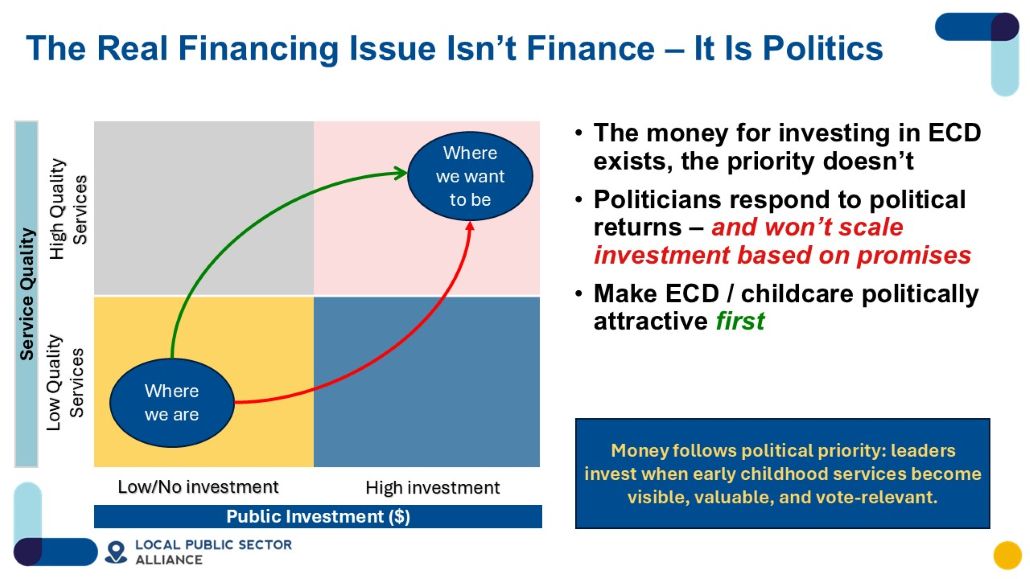
From that perspective, the real pathway looks more like a “political arrow”: decision‑makers are willing to move along the investment axis when they are convinced that better services will translate into political returns. What looks to practitioners like a public finance management challenge is, for many political decision-makers, an incentive challenge: which programs are visible, valued, and vote‑relevant?
Three domestic public finance levers for childcare
Within this political reality, there are concrete opportunities to use existing public finance instruments for childcare at the subnational level in Kenya, once political leaders are convinced the sector provides political value-for-money. LPSA highlighted three levers:
1. Untapped fiscal space in existing intergovernmental transfers. Under the equitable share, county governments receive a population‑based share of nationally raised revenue, and childcare falls under “other county services.” The KSh. 7.39 billion indicative allocation for childcare is not an abstract number; it represents real fiscal space that counties could use for young children if childcare became a serious political priority. The challenge is to help counties see and claim this space, not to assume that new taxes or completely new funding streams are the only answer.
2. Conditional and performance‑based grants. Kenya already uses conditional grants in sectors such as health to steer county spending and uphold minimum standards. At the moment, however, very little of the financing from international financial institutions and development partners for early childhood passes directly through county systems; most support still flows via national projects or CSO projects.
Once childcare is better regulated and integrated into county systems, similar conditional instruments could co‑finance childcare – for example, grants per registered provider meeting minimum norms, or grants tied to coverage in low‑income areas and informal settlements. Well‑designed matching grants, where external funds top up county allocations for “soft” functions such as training, supervision, and materials, could help nudge counties to invest beyond visible infrastructure. These instruments work best after there is a functioning, regulated sector and political ownership at county level; they cannot substitute for that ownership.
3. County own‑source revenues and fiscal incentives. Own‑source revenues represent roughly nine percent of county funding, plus about three percent from facility‑level receipts. They will not finance the entire childcare agenda, but they are flexible. Counties can use them strategically to reduce license fees for childcare providers, offer property‑tax rebates for employers that host childcare on site, or earmark a portion of market fees to support market‑based crèches. These small fiscal nudges can help align local economic interests with early childhood priorities.
Across all three streams, a cross‑cutting opportunity exists: to leverage household and community spending through smarter public finance. In Nairobi alone, there are several thousand largely informal childcare providers financed mainly by parental fees. Targeted public subsidies for demand (vouchers or fee top‑ups for low‑income families) and for quality (infrastructure grants, training linked to standards) can pull this spending into a regulated, quality‑assured ecosystem, rather than attempting to replace it outright.
The real question: how do we generate political will?
The core of LPSA’s message in Kigali was that evidence and fiscal‑space calculations are necessary but not sufficient. If the discussion stops at “what public financing sources are available?”, it comes too late in the story. The earlier question is: how do we make childcare and early childhood services politically attractive enough that decision‑makers choose to allocate the resources they already control?
From our work in Kenya, three practical principles emerge for generating political will:
1. Don’t do for government what government should be doing itself. When external actors fully fund and deliver childcare services, they may provide short‑term benefits but often undermine long‑term political ownership. If counties never have to take explicit decisions or face their constituents about childcare, they have little reason to prioritize it.
2. Don’t set the bar so high that government cannot achieve it. Over‑ambitious designs can discourage political engagement. Early years advocates should help national and county governments define attainable steps that fit their capacity and political realities, rather than designing ideal systems that are impossible to implement.
3. Start with low‑hanging fruit that gives political credit to local leaders. Practical examples include funding or co‑funding training for childcare providers and organizing public certification events where governors or county executives award certificates. These are relatively inexpensive interventions that improve quality and, crucially, allow leaders to be visibly associated with positive change in the childcare sector.
Looking ahead
LPSA is grateful to ECDAN, AFeCN, UNESCO, UNICEF and WHO for convening this timely forum, and for making space for a multilevel‑governance and political‑economy perspective on early years financing.
For us, the takeaway from Kigali is clear: the real financing challenge for childcare and ECD is not simply “where do we find more money?”, but how do we align intergovernmental finance systems and political incentives across different government levels so that leaders want to put money on the table for young children? Answering this question requires sustained partnerships between early childhood development organizations and experts with the community of practice on decentralization and multilevel governance.
Read more about LPSA’s efforts to support Localizing Women’s Economic Empowerment and Childcare in Africa on the Localizing Women’s Economic Empowerment and Childcare in Africa project page.