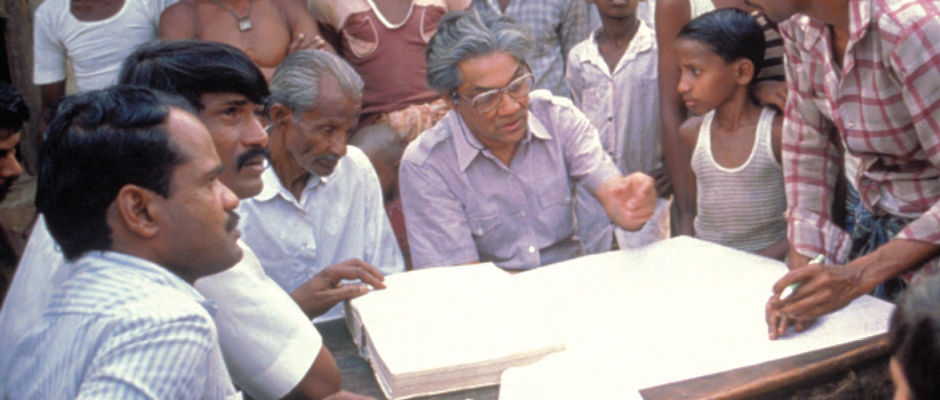
One of the central promises of decentralization is that it can create political space for those historically excluded from power. In theory, local governance is the arena where marginalized voices—whether of caste, ethnicity, or gender—can gain entry and, over time, reshape the broader political landscape. This promise has been particularly powerful in debates around gender quotas: if women are guaranteed seats at the village level, might they not eventually ascend to higher offices as well?
The idea of such “spillover effects” is intuitively compelling. Local politics should, in principle, provide women with opportunities to develop political skills, increase visibility, and challenge gender stereotypes. Yet whether these pathways actually extend upward is far from certain. A recent study by Anjali Thomas, Charles Hankla, Sayan Banerjee, and Arindam Banerjee investigates this very question through a survey experiment in Bihar, India—a state where local quotas for women are among the strongest in the country but where women’s representation at higher tiers remains strikingly low.
Their findings are sobering. While quotas do succeed in bringing women into local office, they do not necessarily translate into greater support for women in state-level elections. In fact, under some conditions, they appear to generate backlash among precisely those men who might otherwise have supported women’s candidacies. The story, then, is not one of straightforward empowerment but of complex and sometimes contradictory responses to institutional reform.
The Promise of Local Quotas
India’s constitutional amendment of 1993 mandated that one-third of seats in village councils be reserved for women, later expanded in Bihar to one-half. This move was hailed as transformative, placing tens of thousands of women into positions of authority as Mukhiyas (village heads). By 2016, women occupied nearly half of all such offices in Bihar.
Existing scholarship has shown that these quotas matter: they alter budget priorities, encourage political participation by women, and shift local attitudes about female leadership. At the same time, optimism has spread that such reforms might ripple outward, opening higher offices to women as well. If voters encounter effective female leaders in their villages, the argument goes, they might be more willing to trust and elect women at the state or national level. This is the “multi-level learning” hypothesis.
Yet there is another possibility. Exposure to women leaders could provoke resistance, especially among men invested in patriarchal hierarchies. This “multi-level backlash” hypothesis suggests that quotas might reduce, rather than enhance, support for women at higher levels of office.
A Survey Experiment in Bihar
The authors tested these competing logics with a conjoint survey experiment involving nearly 2,000 respondents across Bihar. Participants were asked to choose between hypothetical state-level candidates whose traits—gender, caste, party, and policy priorities—were randomized. Crucially, the researchers could compare responses across villages where the Mukhiya position was reserved for a woman versus those where it was not, exploiting the fact that these reservations are assigned “as if randomly.”
The experiment was supplemented with more than sixty qualitative interviews, which provided valuable insight into how citizens perceived their local leaders. Together, these data offered a rare opportunity to examine how institutional design at the local level interacts with voter attitudes at the state level.
No learning, but backlash
The results offer little support for the multi-level learning hypothesis. Even when female Mukhiyas were seen as effective problem-solvers, respondents did not become more likely to support female candidates at the state level. In short, competence at the village level did not translate into greater demand for women in higher office.
More strikingly, the study uncovered evidence of multi-level backlash—but in a specific and unexpected way. Men from households with relatively higher levels of female autonomy, whom the authors call “partially progressive,” showed a preference for female candidates at the state level when no local quota was in place. Yet this preference disappeared when their village was represented by a quota-elected woman. For these men, it seems that one woman in office was acceptable, even desirable, but two felt like too much.
This tipping-point logic suggests that incremental representation may initially be welcomed but that additional gains provoke resistance. By contrast, men from more conservative households, who never preferred female candidates, remained unaffected by quotas. Women’s preferences also showed little change, with some evidence that those from less empowered households might respond positively to exposure, though not at statistically significant levels.
Implications for decentralization and representation
These findings complicate the narrative that decentralization automatically builds inclusive pipelines to higher office. While local quotas do expand the supply of women with political experience, they do not reliably shift voter demand in ways that would sustain women’s candidacies beyond the village. Indeed, they may erode support among the very segment of male voters most open to women’s leadership.
This tension highlights a crucial point for policymakers: reforms at the local level cannot be assumed to translate smoothly into systemic change. Gender quotas at higher tiers may be necessary in their own right rather than relying on the gradual diffusion of acceptance from below. Moreover, the study suggests that the social dynamics of representation are deeply contingent. Factors such as household gender norms, caste intersections, and local political histories all shape whether quotas are met with learning or backlash.
Conclusion
The Bihar experience demonstrates that decentralization’s promise of empowerment is not automatic. Local quotas succeed in guaranteeing women seats but do not necessarily prepare the ground for their success at higher levels. Instead, they may trigger ambivalent reactions, including backlash from those men who seem most amenable to women’s representation.
For advocates of decentralization and gender equality, the lesson is clear: institutional reforms must anticipate not only the supply of candidates but also the demand-side dynamics of voter attitudes. Quotas at higher levels may need to be pursued directly, accompanied by broader social strategies to challenge the tipping-point mentality that regards limited representation as sufficient.
In the end, the study underscores that democratizing representation is not a linear process. It involves negotiation, resistance, and recalibration at every level. If decentralization is to serve as a pathway toward equality, we must be attentive not only to its formal rules but also to the shifting perceptions and reactions they generate.
Read the entire article:
Thomas, Anjali, Charles Hankla, Sayan Banerjee, and Arindam Banerjee. 2024. Do Local Gender Quotas Improve the Electability of Women at Higher Tiers? Evidence from a Survey Experiment in North India. Governance and Local Development Institute Working Paper No. 67.
Available at SSRN: https://ssrn.com/abstract=4732995 or http://dx.doi.org/10.2139/ssrn.4732995
Note: The Feature Image for this blog is AI generated.