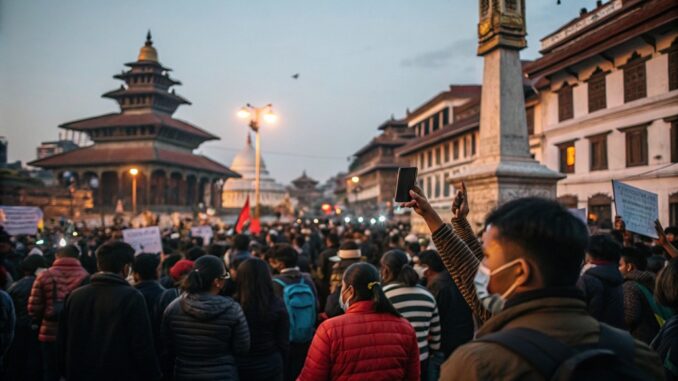
Over the past several years, countries across different parts of the world—including Africa, South Asia, the Middle East, Europe, and Latin America—have experienced a surge of youth-led protest movements often referred to as “Gen Z uprisings.” While these movements are often triggered by immediate events—such as social-media restrictions, poor service delivery, corruption scandals, or price shocks—their underlying drivers are structural. They reflect the cumulative frustrations of a young generation confronting diminished economic prospects, weak public services, centralized decision-making, and political systems that feel distant and unresponsive.
These concerns map directly onto the core functions of multilevel governance. Gen Z’s demands are not merely social or economic grievances; they reveal deeper governance challenges that stem from how public authority, responsibilities, and resources are structured across levels of government.
This policy brief outlines the nexus between Gen Z’s concerns and the need for more inclusive, effective, and responsive multilevel governance systems.
Generation Z’s demands reflect structural governance failures
Across different countries, young people of Generation Z are rising up in ways that share some common demands and motivations. Their core demands include fairness, opportunity, and basic services:
- Limited economic opportunity and persistent youth unemployment. Many Gen Z protesters highlight high youth unemployment and bleak economic prospects. They demand better access to jobs, fair wages, and opportunities for upward mobility.
- Unequal access to quality public services. In several countries, protests have demanded improvements in health care, education, and overall public infrastructure. For example, in Morocco, protesters under the banner of GenZ 212 have demanded better public health care and education
- Corruption, elite capture, and lack of accountability. A central grievance is that political or economic elites benefit from state resources, while ordinary youth are left behind. Demonstrators want accountability, transparency, and an end to policies that favor the well-connected.
- Challenging the social contract. Young people are not only protesting corruption; they are demanding value-for-money from the public sector—questioning why government taxes are high while government money is spent on costly foreign trips by government officials or poorly justified projects. In Kenya, for example, Gen Z protesters translated the costs of state visits or official travel into concrete social benefits that could have been funded instead, such as sanitary supplies for schoolgirls, to illustrate the disconnect between public spending and public priorities.
- Barriers to meaningful civic participation and political voice. There is frustration with traditional political systems, which many young people feel ignore or marginalize them. Some protests call for more democratic participation, fairer governance, and pathways for youth to influence policymaking.
These issues are symptoms of governance systems in which authority is overly centralized, fiscal resources are distributed inequitable, and local governments lack the mandate or resources to respond to local priorities. Their demands therefore point toward fundamental questions about the efficiency and responsiveness of the public sector, and how power and resources are distributed within the state.
Governance failures affect young people more directly and more intensely
Gen Z experiences the consequences of ineffective multilevel governance with particular severity. In many contexts, centralized decision-making leads to service delivery failures that directly affect youth—from public education and training systems to recreation, transport, and safety. Ineffective and unresponsive multilevel governance systems prevent subnational governments from identifying the needs of local constituents and tailoring solutions to the needs of young people. These challenges are often compounded by fragmented functional mandates that result in unclear responsibility for local problems, or inequitable resource allocations that leave some communities significantly underserved.
Because young people often rely heavily on public systems—schools, health clinics, transit, and public spaces—they are the first to feel the effects when these systems break down. Their mobilization is therefore a reflection of the governance gap between national-level policy intent and realities on the ground.
Gen Z seeks transparency, voice, and participation—all strengthened through decentralized and inclusive governance
Gen Z’s outlook is driven by the ubiquitous role that information technology plays in their lives, as Gen Z is the most globally-informed, digitally connected, participatory, and data-driven generation to date. Their engagement with technology has shaped their expectations that citizens should have open, real-time access to information; that information technology should be used as channels for expressing preferences; that budgeting and decision-making should be transparent and inclusive; and that opportunities should exist for collective decisions to be influenced local policy preferences.
Effective multilevel governance—enabled by strong local governance institutions, clear mandates, responsive administrative structures, and participatory mechanisms—provides the institutional space for these expectations to be met. Decentralized systems with robust local accountability allow young people to see how decisions are made and who is responsible for outcomes, creating a closer and more credible link between voice and policy action.
A new constituency for decentralization and local governance knowledge
Many countries face a unique demographic moment: large youth populations entering adulthood amid tightening fiscal space, institutional inertia, and mounting service delivery pressures. This demographic shock converges with a persistent governance gap, generating frustration and instability.
Inclusive and effective multilevel governance is one of the few systemic reforms capable of addressing these frustrations at scale. Stronger subnational governments—empowered through clear mandates, adequate resources, and meaningful accountability—can serve as engines of opportunity, participation, and more equitable service delivery.
Generation Z is emerging as an unexpected but powerful constituency for decentralization and local governance reform. Their demands—for fairness, transparency, accountability, and meaningful participation—mirror many of the long-standing principles that underpin effective multilevel governance. What youth across regions are articulating is not simply frustration with isolated policy failures; rather, they are expressing an intuitive understanding that centralized systems too often fail to reflect local realities or respond to community needs. As a result, Gen Z is increasingly aligned with the notion that governance must be brought closer to people, services, and problems if it is to be credible and inclusive.
At the same time, Gen Z’s digital fluency and expectations for open information create a natural synergy with the decentralization and local governance agenda. Their everyday interactions with technology reinforce a belief that decision-making should be transparent, data-driven, and accessible in real time—and that public institutions should be organized in ways that allow citizens to see who is responsible for what. These instincts resonate strongly with core features of decentralized systems: subsidiarity, equitable intergovernmental finance, accountable service delivery, participatory democracy, and open, networked government. In many ways, Gen Z is demanding the very institutional conditions that local governance practitioners have long advocated but struggled to socialize beyond technical circles.
Conclusion
Gen Z protests are not only expressions of economic frustration—they are a generational demand for more responsive, transparent, equitable, and participatory governance. Strengthening multilevel governance systems provides a direct pathway to address these concerns.
For policymakers, philanthropists, and development partners promoting inclusive governance and sustainable development, engaging Gen Z as potential partners and advocates for more inclusive decentralization, effective multilevel governance, and responsive local governance represent both an opportunity and a necessity as a foundation for building more inclusive and resilient states and communities.
Download the LPSA Policy Brief: “Gen Z Protests, Governance Frustration, and the Case for Inclusive and Effective Multilevel Governance” Jamie Boex and Jacqueline Muthura, December 2025.
Note: The Feature Image is generated with the help of AI.