
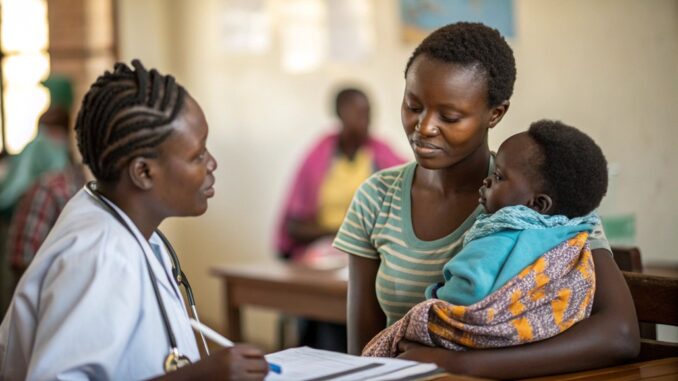
On December 6, the governments of Kenya and the United States announced a major five-year, $2.5 billion cooperation framework to strengthen Kenya’s health sector. The agreement signals renewed American commitment to supporting Kenya’s efforts to advance universal health coverage, expand access to essential services, and strengthen key health programs ranging from HIV/AIDS to pandemic preparedness.
This is welcome news. Kenya’s health system faces enormous pressures, and external partnerships—when designed well—can help address gaps in financing, technology, and capacity.
From a multilevel governance and decentralization perspective, however, the announcement raises a deeper concern: virtually nothing in the new U.S.–Kenya framework suggests that these resources will be aligned with the realities of devolved service delivery.
The responsibility for primary health services in Kenya is devolved
Since 2013, the Kenya’s 47 county governments have been responsible for nearly all frontline public health functions: county governments own and operate county hospitals, health centers and dispensaries, and thus are the primary stakeholder responsible for the frontline provision of public health services, health workforce management, public health outreach, as well as the management of medical supplies and commodities. The national government retains policy, regulatory, and tertiary-referral responsibilities, but whether or not Kenya achieves universal health coverage is ultimately a function of what happens at the county level.
Yet most external financing, including the new U.S. package, continues to flow through—or be negotiated with—the national government. In a context where intergovernmental resource flows already suffer from vertical imbalances and weak alignment with constitutional assignments, this is more than a technical oversight. It risks reinforcing the very system weaknesses that devolution sought to correct.
When resources stay at the top, service delivery suffers at the bottom
Kenya’s intergovernmental fiscal architecture continues to underfund county governments relative to their constitutional responsibilities. Although counties manage most frontline services—health, roads, water, early childhood education, urban services, and more—they control only a small share of total public resources. County governments execute roughly 13.6% of total public expenditures in Kenya, even after excluding debt service. This persistent vertical imbalance means that the level of government legally responsible for delivering services rarely receives the resources needed to deliver them effectively.
In the health sector, the result is a system in which national-level allocations remain disproportionately high relative to national functions—while counties must stretch limited budgets across sprawling facility networks, inadequate infrastructure, and rising input costs. The county resources made available for health services represent around 2,200 Kenyan Shillings (or roughly 17 dollars) per person for the delivery of frontline health services, funding—in aggregate—48.8 million patient visits to county health facilities. Yet, despite its narrow functional mandate, national government retains roughly half of Kenya’s total health resources for its policy functions, and for managing a handful of tertiary hospitals.
While counties are responsible for nearly all frontline health services, the health sector lacks an intergovernmental system that publicly tracks or supports counties’ overall performance in the health sector. Despite a significant investment in data collection, the country lacks a clear, system-wide picture of the most basic metrics: How many patients are counties actually being served with the resources that counties receive? What is the overall level of access to public health services in different counties? And what is the average cost per patient in different counties?
Without routinely measuring these fundamentals, neither national policymakers nor county health officials can assess whether devolution is delivering value for money or identify where health service delivery is falling short. Rather than focusing on results and value-for-money, sectoral officials at both levels seem to be focused on increasing sectoral funding. As a result, money “sticks where it hits”, rather than being used in an efficient manner to achieve its stated health policy ambitions.
A donor framework that ignores the governance architecture of health
The new U.S.–Kenya health cooperation framework does nothing to address this imbalance. It provides no indication that additional resources will be channeled to counties, nor that the partnership will strengthen county-level planning, budgeting, human resources, or performance management systems—the actual backbone of service delivery. Instead, the announcement largely reinforces the centrality of national ministries and agencies, bypassing the level of government that the Constitution positions as the engine of public service delivery.
The new cooperation framework emphasizes important programmatic areas—HIV, reproductive health, supply chains, health security—but it is largely silent on how these investments will flow through a devolved system.
- It does not acknowledge that the day-to-day operations of Kenya’s public health system are managed by counties.
- It does not commit to strengthening county planning, budgeting, or expenditure management systems.
- It does not propose improving the vertical allocation of health financing in line with the Constitution.
- And it offers no strategy to address the likely horizontal inequities and inefficiencies of county-level health performance.
In fact, in the context of Kenya’s malfunctioning intergovernmental systems, the U.S. funding agreement is likely to add to greater inefficiency in health spending as “frontline health workers currently funded by the U.S. government will be mapped to the cadres of health workers that can be employed by the Kenyan government, and those cadres of health workers will be transitioned over to the Kenyan government payroll”. In other words, the implementation of the agreement will almost lock in greater national health spending, despite the fact that the national government lacks the constitutional responsibility to deliver front line health services.
This mismatch reflects a broader pattern in global health financing: large, centralized donor agreements negotiated at the national level, implemented through vertical programs, and only marginally connected to the county health facilities that citizens depend on. The risk is that new resources will continue to “stick” at the top—funding policy units, regulatory agencies, and national-level initiatives—while county governments remain underfunded, under-supported, and over-expected.
A better way forward: devolution-aligned health partnerships
If external health financing is to improve real outcomes for Kenyans, donors must engage with the system actually responsible for delivering services. That means three shifts:
1. Align financing with constitutional responsibilities. Donor financing should reinforce—not override—Kenya’s devolved system. This means ensuring that a meaningful share of external resources reaches counties, either through conditional grants, co-financing mechanisms, or direct support for county health systems.
2. Address horizontal inequities through data-driven allocation formulas. Beyond data collection, an intergovernmental coordination framework is needed to monitor county health spending and to make sure that counties fund and implement their constitutional mandates with respect to health services. The Government of Kenya should commit to making sure that county-level funding allocations—both from the Equitable Sharing, as well as from conditional sector grants—are made and used in ways that respond to the needs of Kenyans to receive health services.
3. Support counties in improving service delivery capacity and accountability. Moving greater resources to the front line is onlypart of the solution: it is equally important that resources get transformed efficiently into county health services. This will require strengthening county PFM systems, human resource management, KHIS reporting quality, facility-level resource allocations, and facility-level performance monitoring.
Conclusion
Kenya does not need more centralized health financing. It needs better-aligned and better-governed health financing—financing that strengthens the level of government responsible for serving citizens.
The new U.S.–Kenya cooperation framework is an important investment in Kenya’s future. But unless the framework is reshaped to account for the country’s devolved system—its vertical imbalances, horizontal inequities, and county-level performance realities—it risks becoming another well-intentioned initiative that reinforces rather than resolves the structural weaknesses of Kenya’s health sector. As the framework is written now, neither American taxpayers, nor Kenyan families are likely to receive good value-for-money.
Note: This blog was written by Jamie Boex, Executive Director of the Local Public Sector Alliance. The opinions and conclusions reflect those of the author, and should not be attributed to the Local Public Sector Alliance.
Note: The Feature Image for this blog post was generated with the help of AI.

