

Public Sector Leadership Course
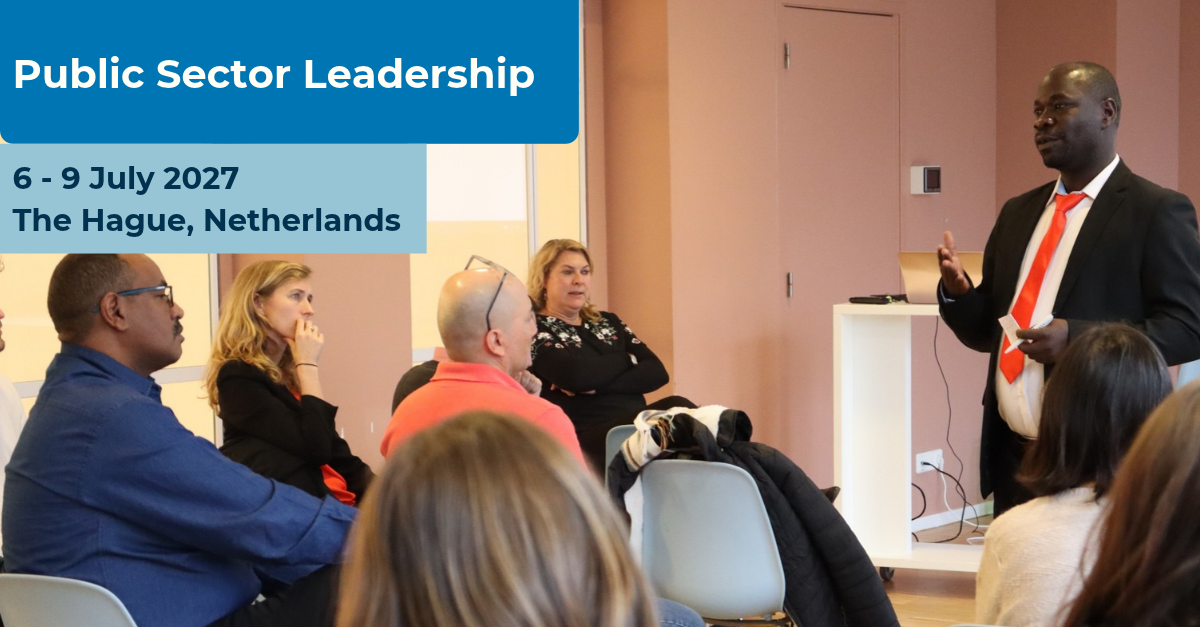
Public leaders around the world are increasingly held accountable for outcomes they cannot achieve through their own organisation alone. Challenges such as social inequality, climate adaptation, migration, economic development and public-sector reform involve multiple authorities, sectoral expertise and community interests. Conventional command-and-control approaches are insufficient. Leaders must work across organisations whose representatives may operate under different mandates and incentives, hold unequal levels of authority, information and resources, and disagree about both the nature of the problem and the desired outcome. Changes such as new appointments or organisational restructuring, political feasibility, shifts in public values or technical recommendations, often occur following elections but also unexpectedly. The result is a highly challenging leadership reality.
Additionally, there is often a gap between detailed procedures and what work environments requires. Specific public leadership skills are needed to diagnose complex and adaptive challenges, understand systems, interests and power relations, and work constructively with elected and appointed officials. Other challenges that public leaders face are to translate technical evidence into meaningful policy choices, and to facilitate collective decision-making beyond hierarchical authority. Furthermore, they need to maintain trust and continuity when people and political priorities change, and uphold integrity and accountability in ambiguous situations. Developing these capabilities requires sensing, probing and repeated practice. This training is designed to equip participants with adequate tools and concepts, providing a space for experimentation, guided reflection and peer exchanges.

