

Local Climate Response Course
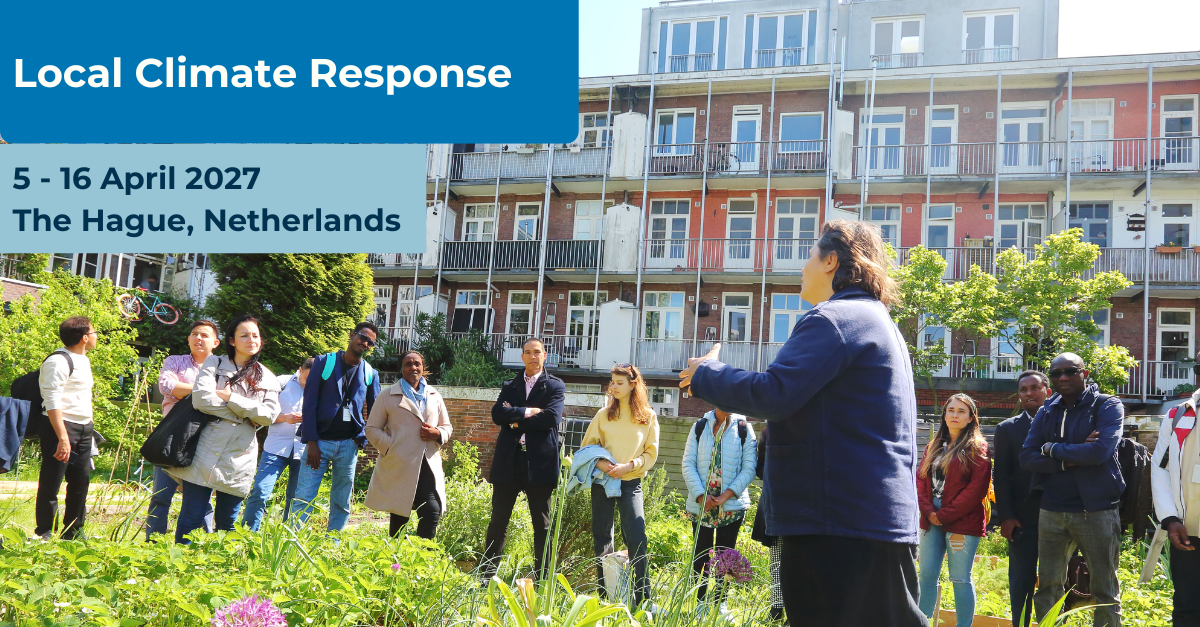
As a result of climate change, local authorities and their citizens are increasingly faced with problems such as air pollution and water scarcity. Moreover, the security and livelihoods of millions are threatened by droughts, floods, and other natural disasters. To address these challenges, local governments – in cooperation with national and local stakeholders – must develop strategies that respond to current and future climate change.
In this course, we will discuss climate change scenarios across multiple sectors and explore their policy implications. Furthermore, participants will assess local climate vulnerabilities in their own local context, and discuss possible strategies to build local resilience. The focus is on designing sustainable adaptation plans that support communities and local ecosystems, for example, by developing nature based solutions. Participants will also map national and international opportunities to finance climate adaptation, and they will learn how to incorporate climate justice principles in local policies.
Guided by high-level, international experts, course participants will learn about:
- Tools to assess climate vulnerabilities
- Strategies for adaptation, disaster risk reduction, and climate resilience
- Community-based climate policies and citizen engagement
- Nature-based solutions (NbS)
- Energy transition strategies
- Financing climate policies, e.g. climate funds and public-private partnerships
- Linkages between climate change and social inequalities and strategies to promote climate justice
The programme (previously) includes visits institutions such as TU Delft’s Green Village, the ecological neighbourhood Eva-Lanxmeer, and exchange with the Climate Adaptation the Resilience Teams of the city of The Hague.
We offer a 50% fee reduction for staff of local governments or local NGOs in countries on the OECD-DAC list
Learn more and apply on our website: https://thehagueacademy.com/course/climate-adaptation-local-resilience/

