
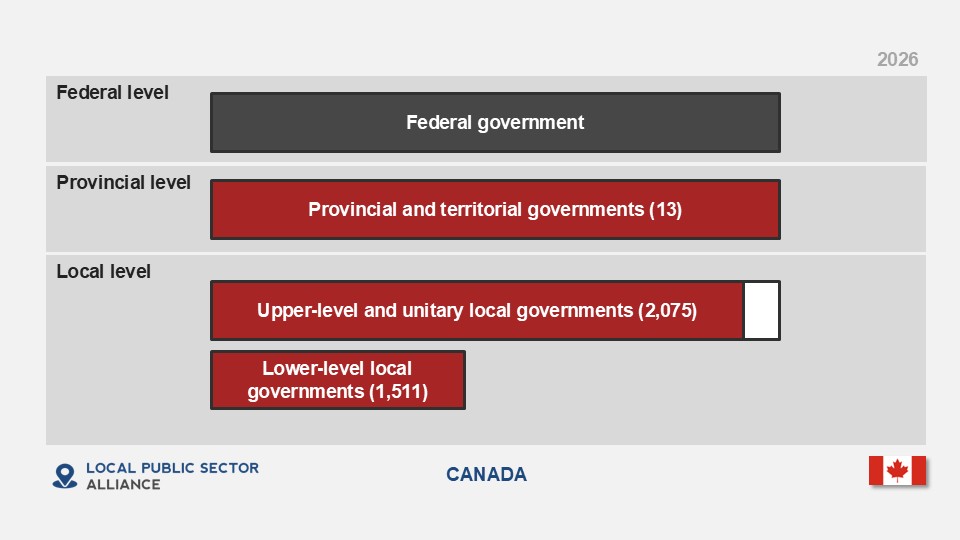
Canada is a federal parliamentary state comprising the federal government, 10 provinces and three territories, and a diverse system of municipal and Indigenous governments. The Constitution Act, 1867, divides legislative authority between the federal Parliament and provincial legislatures, with provinces possessing constitutionally protected legislative authority over major areas including health, education, property and civil rights, natural resources, local matters, and “municipal institutions in the province.” The three territories—Yukon, Northwest Territories and Nunavut—occupy a similar functional position in Canada’s multilevel governance system but have a different constitutional basis: their legislative powers are devolved by federal legislation rather than constitutionally inherent. Municipal governments, in turn, do not constitute a constitutionally autonomous order of government: their institutional form, powers and responsibilities are determined primarily by provincial or territorial legislation. Indigenous governments add an important and increasingly significant dimension to Canadian multilevel governance, including First Nations governments and governments established through modern treaties and self-government agreements.
Subnational governance structure
Canada’s subnational governance structure consists of 10 provinces and three territories, below which local governance arrangements vary considerably across the country. Provinces and territories constitute the principal regional level of government, while each establishes its own system of municipal and local governance. In most provinces and territories, municipalities of different types—such as cities, towns, villages, rural municipalities, counties, municipal districts and specialized municipalities—operate at a single local governance level, despite differences in size, designation and functional responsibilities.
Ontario, Quebec and British Columbia have more complex arrangements involving both area-wide and constituent municipal institutions. Ontario combines upper-tier counties and regional municipalities with constituent lower-tier municipalities, while substantial parts of the province are governed by single-tier municipalities that perform both sets of functions. Quebec similarly combines regional county municipalities (municipalités régionales de comté, or MRCs) with constituent local municipalities, alongside municipalities exercising MRC-equivalent responsibilities. British Columbia’s municipalities participate in regional districts, which provide regional, subregional and local services through a more federative and flexible model rather than a conventional hierarchical two-tier system.
Indigenous governments form an additional and legally distinct component of Canada’s subnational governance landscape and should be considered separately from the provincial and territorial municipal systems.
Nature of subnational governance institutions
Canada’s provincial governments are fully devolved, constitutionally entrenched governments, with directly elected legislatures, their own executive administrations, extensive legislative and regulatory authority, and substantial own-source taxing and borrowing powers. Their authority is not delegated by the federal government, and the federal government cannot ordinarily abolish provinces or unilaterally assume matters assigned to them by the Constitution. The territories exercise many comparable governmental functions and have elected legislatures, responsible governments, their own public administrations and substantial expenditure responsibilities, but their authority is legally devolved through federal statutes and therefore has a different constitutional foundation.
Provincial governments establish and can restructure their municipal systems, while the practical degree of local autonomy varies across provinces. Section 92(8) of the Constitution expressly assigns authority over “Municipal Institutions in the Province” to provincial legislatures. Across all provinces and territories, Canadian municipalities are fully devolved institutions, as incorporated institutional units with elected councils, their own administrations and employees, budgets, assets, revenues and meaningful discretion over assigned local functions.
Indigenous governments have a distinct legal and institutional basis and should be identified separately rather than subsumed under provincial municipal systems; this is especially important in the northern territories, where Indigenous and public local-government institutions sometimes overlap or interact.
Functional assignments
Canada has a highly decentralized assignment of public functions. The federal government is responsible for matters including defense, foreign affairs, international and interprovincial trade, currency and banking, criminal law and other national functions, while provinces exercise major responsibilities for health care, education, social services, natural resources, property and civil rights, administration of justice, and the establishment of municipal institutions.
Municipal functional assignments vary considerably by province but commonly encompass local roads and streets, water and wastewater, solid-waste management, land-use planning and development control, fire protection, parks and recreation, public transit, local economic development and other community services; larger municipalities frequently perform additional social, housing, policing and transportation functions. In provinces with two-tier systems these responsibilities are divided between upper- and lower-tier institutions: regional functions and services benefiting from scale are generally placed at the upper level, while more localized services remain with constituent municipalities. Thus, while Canada has a common constitutional architecture, the actual assignment of local functions is substantially province-specific.
LoGICA Assessment
LoGICA Intergovernmental Profile: Canada, 2026 (Excel)
Additional resources
Government of Canada, Department of Justice. Constitution Acts, 1867 to 1982.
Forum of Federations. 2002. Federalism and Decentralization in Canada.
Commonwealth Local Government Forum (CLGF). The Local Government System in Canada.
OECD/UCLG. World Observatory on Subnational Government Finance and Investment (SNG-WOFI): Canada Country Profile.
UN Women. Women in Local Government – Canada country profile.
Back to Local Public Sector Alliance Intergovernmental Profiles – Country Page
Last updated: September 28, 2026

