
Papua New Guinea (PNG) is a unitary parliamentary democracy with a constitutional framework for decentralized governance. Since independence in 1975, the country has pursued several rounds of decentralization reforms, most notably through the 1995 Organic Law on Provincial Governments and Local-level Governments, which substantially restructured subnational governance. Although provincial and local-level institutions have legally recognized responsibilities, PNG remains highly centralized in fiscal and administrative terms. The national government retains considerable control over public revenues, personnel and major service delivery functions, while subnational governments depend heavily on intergovernmental transfers. Governance arrangements are further complicated by the prominent role of national Members of Parliament in directing development resources within their constituencies, often through mechanisms operating alongside regular subnational administrative structures.
Subnational governance structure
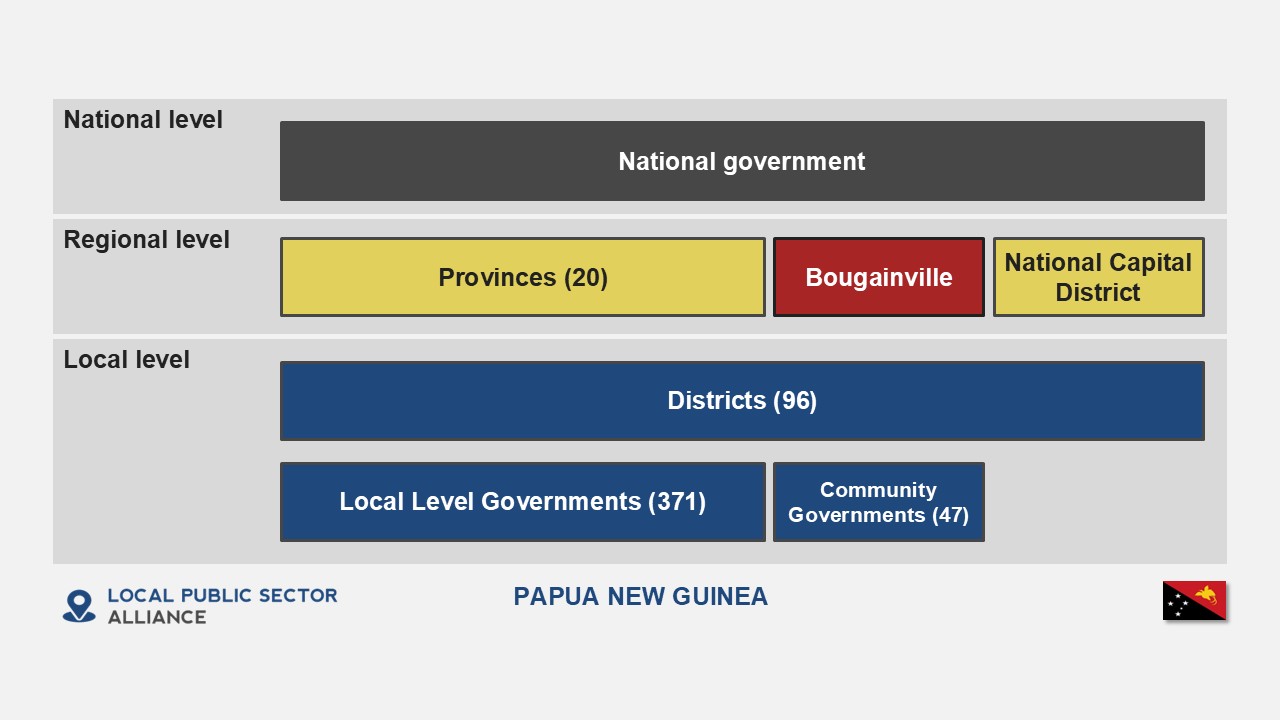
PNG’s subnational governance structure comprises 20 provinces, the Autonomous Region of Bougainville and the National Capital District (NCD) at the regional level. At the local level, the country is divided into 96 districts, which serve as electoral constituencies and administrative jurisdictions, and 371 Local-level Governments (LLGs). Bougainville has a distinctive autonomous governance structure, including its own elected government and legislature, and 47 Community Governments that perform functions broadly equivalent to LLGs elsewhere. The National Capital District has separate governance arrangements and does not have regular LLGs. Districts are particularly complex institutional units: they encompass deconcentrated district administrations and District Development Authorities (DDAs), statutory bodies chaired by the respective national Members of Parliament. The resulting structure combines territorial government institutions, deconcentrated administrative units and special-purpose development authorities.
Nature of subnational governance institutions
PNG’s subnational governance arrangements combine elements of devolution, deconcentration and vertical political control through shared (national-provincial-local) parliamentary representation. Provincial governments should be understood as hybrid institutions: they have political leadership, legislative powers, budgets and assigned responsibilities, but their administrative and fiscal autonomy remains constrained by national government control, particularly over public-service personnel. Bougainville is an important exception, with extensive devolved powers, its own elected government and a separate public service. Districts are non-devolved institutions, with deconcentrated district administrations operating alongside District Development Authorities (DDAs). Each DDA is chaired by the district’s elected national MP, has the (nationally-appointed) District Administrator as its CEO, and is governed by a Board that includes the district’s LLG presidents. Similarly, Local-Level Governments should also be considered as non-devolved institutions, despite having elected representative bodies and some statutory powers, because they lack (control over) their own staff: LLG managers are employed and paid on their behalf as part of the national public service.
Functional assignments
PNG’s legal framework assigns provincial and local-level governments responsibilities for a range of public services and development activities, but actual service delivery remains fragmented across national agencies, provincial administrations, districts and local institutions. Provincial governments play an important role in coordinating and supporting education, health, infrastructure maintenance, agricultural services and other provincial functions, although frontline personnel often remain within the national public service or sector-specific authorities, such as Provincial Health Authorities. District administrations provide deconcentrated support for routine services, while District Development Authorities primarily finance and implement infrastructure and development projects through centrally funded programs. Local-Level Governments have statutory responsibilities for local planning, community infrastructure, markets, sanitation and other local services, but generally lack the financial and administrative capacity to perform these functions effectively. Bougainville has a broader range of autonomous responsibilities under its special constitutional arrangements. The practical division of responsibilities therefore often differs substantially from formal legal assignments.
LoGICA Assessments
LoGICA Intergovernmental Profile: Papua New Guinea 2026 (Excel)
Additional resources
UN Women, Women in Local Government – Papua New Guinea Country Profile
Commonwealth Local Government Forum (CLGF), The Local Government System in Papua New Guinea
World Bank. 2021. Political Economy and Institutional Context of Sub-National Public Financial Management and Service Delivery in PNG
Maholopa Laveil. 2025. Shining a light on local level government in PNG.
The National Research Institute. 2022. Decentralised Governance Arrangements in PNG.
Back to Local Public Sector Alliance Intergovernmental Profiles – Country Page
Last updated: October 15, 2026

