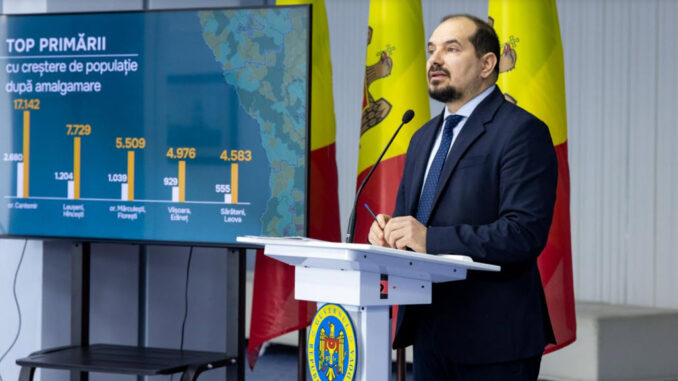
The Republic of Moldova is preparing one of the most ambitious territorial and administrative reforms in its recent history. On October 8, 2026, the Government presented a new administrative-territorial map that would consolidate the country’s approximately 900 local governments into just 273 municipalities, while replacing its existing 32 districts (raioane) with three larger regions. By August 31, 561 mayoralties (63%) had adopted final decisions to merge voluntarily. Other consolidations will be part of the mandatory or “normative”) phase, for localities under a 3,000-resident threshold.
The voluntary phase ran for almost three years—accompanied by financial incentives and technical support from the government and development partners—but produced only two mergers by the end of 2025. The breakthrough came in 2026, when the infrastructure incentive was tripled from 1000 to 3000 Moldovan lei per resident, and a newly appointed Secretary General of the Government took charge of the process.
The proposed reform seeks to address the fragmentation of local government, improve the institutional capacity of local authorities, and strengthen the ability of municipalities to deliver public services and attract investment, including funding associated with the Republic of Moldova’s European integration ambitions.
Addressing local government fragmentation
Under the current structure, approximately 87 percent of the Republic of Moldova’s municipalities have fewer than 3,000 residents. Many smaller communities have experienced significant population decline, making it increasingly difficult to sustain effective local administrations.
The proposed consolidation would increase the average municipal population from approximately 1,900 to 6,800 residents (excluding Chișinău and Bălți). The government also points to substantial differences in administrative costs: municipalities with fewer than 500 residents spend an average of 3,147 Moldovan lei per resident on administration (roughly USD 176), compared with 763 lei in municipalities with more than 3,000 residents (or approximately USD 43).
The fiscal picture shows that although the 2015 local finance reform allocated fully the personal income tax to local governments and introduced a transparent, formula-based equalization system, own revenues account for less than 8 percent of local budgets, and outside Chișinău they declined by about 4 percent in real terms between 2019 and 2024. Voluntarily merged municipalities will receive substantial incentives, including a general-purpose grant until 2030, and the local finance system itself will be adjusted to a new structure from 2028, when newly merged municipalities come to life.
By merging administrative structures and pooling resources, the government hopes to create stronger municipalities with more specialized staff, greater financial capacity, and improved access to digital services. Importantly, the proposal envisages maintaining local administrative service delivery points in smaller communities, specifically where municipal administrations are consolidated. The network of CUPS (Unified Public Service Provision Centers) would be extended from 209 presently to over 800.
Reorganizing the intermediate tier
The reform would also fundamentally reshape the Republic of Moldova’s intermediate level of government. The existing 32 districts would be replaced by three regions—North, Center, and South—with administrative centers in Bălți, Chișinău, and Cahul, respectively.
Under the government’s reform concept, the new regions would have no direct service delivery responsibilities, unlike the existing districts, which still manage important services such as primary and secondary education, public transport, and roads. Instead, the regions would focus primarily on regional development, intermunicipal coordination, and investment projects that exceed the capacity of individual municipalities. Services and institutions currently run by the districts would be either taken over by the state (for instance, public education) or transferred to municipalities (libraries, museums, art schools). Chișinău and Bălți would retain their “municipiu” status, Taraclia would become a second-level “municipiu” and the Autonomous Territorial Unit of Gagauzia would retain its special status.
The government intends to advance the necessary legislation by the end of 2026, with implementation linked to the 2027 local elections.
Balancing efficiency with local democracy
Although the government presents the reform as an opportunity to strengthen local autonomy and service delivery, the proposed consolidation also raises important questions about democratic representation and local accountability.
The Congress of Local Authorities of Moldova (CALM) has expressed concerns about the pace of reform and the adequacy of consultations and impact assessments. It has called for postponing mandatory amalgamation, allowing more time to evaluate voluntary mergers, and ensuring that smaller communities retain meaningful democratic representation. The government, for its part, points to the two-thirds of mayoralties that opted in voluntarily, and to its decision to keep current mandates in place until the 2027 elections.
The Republic of Moldova’s proposed reform illustrates a challenge facing many countries with highly fragmented local government systems: how to build sufficient institutional capacity and achieve the administrative scale needed for effective service delivery without weakening local democracy and citizen engagement.
Ultimately, the success of the reform will depend not simply on reducing the number of municipalities and districts, but on whether the new local and regional institutions are capable of building up their institutional and human resource capacity, administering efficiently their resources, raising their own revenues, and establishing the accountability mechanisms needed to discharge responsibilities and deliver better public services.
Read more (official sources, in Romanian):
- Government presents the proposed new administrative-territorial map (October 8, 2026) — Details of the 273 municipalities and three regions.
- Government presents the concept for reorganizing second-tier local administration (October 1, 2026) — Proposed regional responsibilities and institutional arrangements.
- Government consults district presidents and mayors on the reform (October 1, 2026) — Discussions about decentralization, financing, and implementation.
- Strong Municipalities: Official Local Public Administration Reform Portal — Reform documents, background information, and the proposed administrative map.