

The newly published study by the TALD Facility, Territorial Development and Decentralization in Latin America and the Caribbean: A Comparative Study Across 22 Countries (2025), offers a timely, finely-grained examination of decentralization dynamics in the region — a subject of direct relevance to LPSA’s mission of elevating the debate on decentralization, localization, and multilevel governance.
A region at the crossroads
Countries in Latin America and the Caribbean (LAC) are undergoing major transformations: over 80 % of the region’s population now lives in urban areas, reinforcing the imperative for capable local governance. The study of Territorial Development and Decentralization in Latin America and the Caribbean underscores how the promise of bringing decision-making closer to citizens is often undermined by the persistence of highly centralized states, weak sub-national capacities, and uneven territorial development.
Country Scores: How the 22 Stack Up
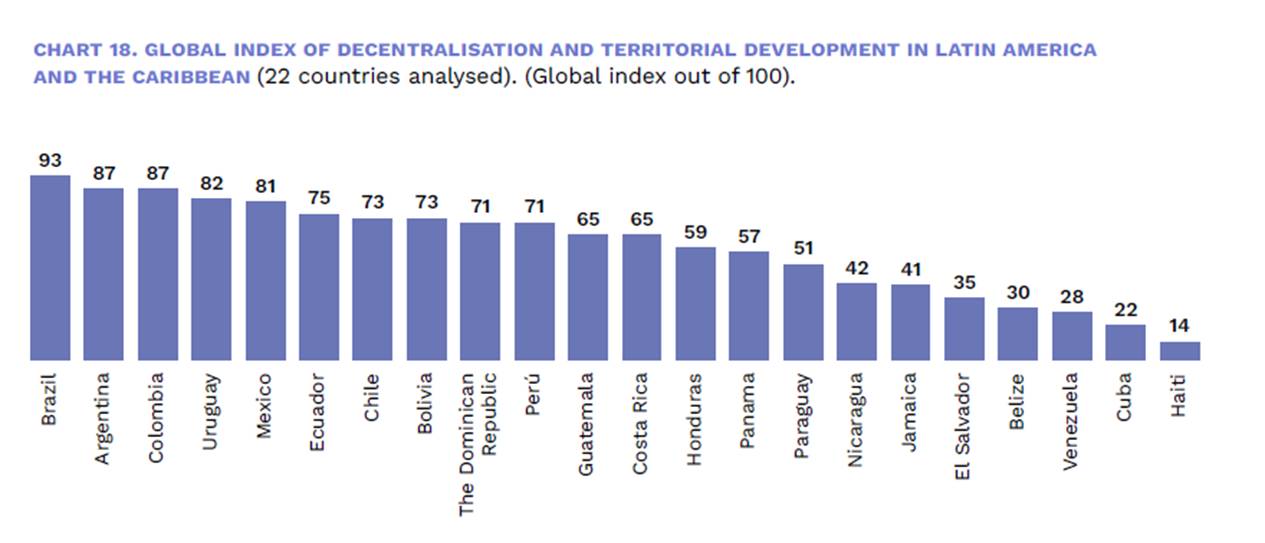
The study assesses 22 countries and evaluates them against ten key factors — from constitutional frameworks and electoral systems to sub-national finances, human resources, accountability and international engagement.
The index underpinning these country scores synthesizes both objective indicators and qualitative assessments across the ten dimensions identified by the TALD study: (i) constitutional system and legal framework; (ii) system for electing sub-national authorities; (iii) women’s participation in sub-national governance; (iv) fiscal autonomy and revenue structures; (v) human-resource stability and merit-based staffing; (vi) planning, budgeting and strategic capacity at subnational level; (vii) accountability and transparency mechanisms; (viii) citizen participation and local democracy practices; (ix) coordination across government tiers and inter-municipal cooperation; and (x) engagement of local/regional governments in international networks and learning.
For each country, data for these ten factors were compiled (drawing on legal/constitutional analysis, official statistics, expert surveys, and case-studies), then converted into standardized scores and aggregated into a single index on a 0-100 scale. Countries were then positioned into the three groups accordingly. This construction allows benchmarking of overall decentralization/territorial-governance performance, while recognizing that underlying factor-level variation may differ widely across countries (e.g., a country may score high on constitutional autonomy but low on fiscal capacity).
Although Latin America is globally recognized as one of the most decentralized (devolved) global regions overall, the analysis recognizes considerable regional variation, with Brazil receiving a score of 93 points (out of 100), while Haiti only receives a score of 14 points.
Key themes for local governance stakeholders
Decentralization is more than a legal formality. The report emphasizes a recurring challenge: countries may enshrine local autonomy legally (de jure), but fail to deliver real operational autonomy (de facto). For practitioners in the local public sector this highlights that the gap between “what the law says” and “what local governments can actually do” remains central to governance performance.
Fiscal autonomy remains a major obstacle. One of the most striking findings: subnational governments across the region manage only a modest share of revenues and expenditures relative to OECD norms. Without sufficient local revenue-raising capacity or predictable transfers, decentralized mandates risk remaining hollow. At the same time, the study further highlights that existing financing models often exacerbate territorial inequalities — municipalities with strong tax bases (typically urban) do far better than economically weaker or rural municipalities.
Capacity, accountability and participation matter. Even where legal frameworks are progressive, many municipalities face weak institutional capacities: unstable human-resource systems (high turnover, politicization), short-term planning horizons, limited transparency or weak citizen-participation mechanisms. For example, the study finds only about ~16 % of mayoralties are held by women — signaling persistent gender gaps at sub-national level. On the accountability side, some smaller municipal tiers still lack open-data systems or accessible public-information portals. For LPSA members, this underscores the importance of strengthening professionalized local administration, aligning budgets with strategic plans, and embedding meaningful participatory mechanisms.
Coordination and multi-level governance pose ongoing challenges. The report observes that vertical alignment (between national, regional, and municipal levels) is often weak in Latin America: mandates are unclear, overlaps exist, and many intra-governmental coordination mechanisms are underdeveloped. At the same time, horizontal cooperation (e.g., municipal associations, metropolitan governance) remains limited. This signals that decentralization isn’t just a zero-sum game between central and local officials — multilevel governance is about ensuring that all levels of government and stakeholders work together to deliver services, manage territory, and enable development.
Conclusion — and a forward-looking note
The analysis of Territorial Development and Decentralization in Latin America and the Caribbean: A Comparative Study Across 22 Countries (2025), provides a rich, data-driven snapshot of where decentralization stands in Latin America and the Caribbean — and implicitly, where it must go next. For those engaged in strengthening local governance and territorial development in the region, the message is clear: law and policy matter, but capacity, finance, coordination and accountability are the levers that unlock transformation.
This study serves as a useful strategic anchor: a benchmarking instrument, a source of diagnostic questions, and a policy-agenda trigger. In the regional context of Latin America and the Caribbean — and beyond — local governance remains the frontline of public-value creation, and the territorial dimension of development deserves our full attention.
TALD Facility. 2025. Territorial Development and Decentralization in Latin America and the Caribbean: A comparative study across 22 countries. Brussels: November 2025.
The report is available in English, Spanish, and Portuguese.
The report was produced by the Territorial Approach to Local Development (TALD) Facility, part of Unit G 2 (Local Authorities, Civil Society and Foundations) of the Directorate-General for International Partnerships (DG INTPA) of the European Commission. The TALD Facility is implemented by the German Agency for International Cooperation, GIZ (Deutsche Gesellschaft für Internationale Zusammenarbeit).
Note: The Feature Image for this blog post was generated with the help of AI.

