
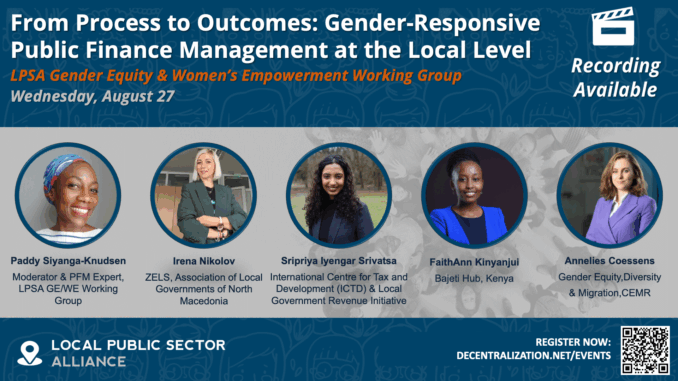
LPSA’s Thematic Working Group (TWG) on Gender Equity & Women’s Empowerment aims to bring together government officials, policy practitioners, scholars, civil society organizations, and citizens who share an interest and expertise at the intersection of decentralization/localization with gender equity and inclusive governance, including local women’s empowerment. The TWG met on August 27, 2025, for an in-depth discussion addressing gender-responsive subnational public finance management, local government practices, and ensuring inclusive participation and outcomes.
Introduction and Framing
The session was moderated by Paddy Siyanga Knudsen, who emphasized the evolving focus of the group from tackling gender-based violence to understanding the transformative role of the local public sector. Attendees were encouraged to connect in the chat and introduce themselves, mirroring the spirit of in-person meetings. The agenda centered on sharing strategies, challenges, and innovations for gender equity at the local level specifically, a deep dive into gender-responsive subnational public finance management and tools for inclusive governance.
Scene-Setting Presentation: European Experience
Annelies Coessens (Council of European Municipalities and Regions) provided a comparative lens from Europe. She illustrated how cities like Vienna institutionalized gender-responsive budgeting and detailed concrete impacts, such as reallocating resources for public safety and childcare. Coessens identified core needs facing local governments globally: usable tools, reliable sex-disaggregated data, and political as well as technical capacity. She noted persistent challenges, including measuring outcomes, political resistance, administrative burdens, and the risk of fragile, partial implementation.
Regional Practice: North Macedonia
Irena Nikolov (Association of Local Governments, North Macedonia) portrayed her association’s pioneering efforts to mainstream gender-responsive budgeting among 81 municipalities, underpinned by the European Charter for Gender Equality. She described local reforms, innovative electronic platforms for sharing practices and data, and measures to expand health services for marginalized groups. Yet, she acknowledged ongoing obstacles related to municipal capacity, data collection, and political buy-in for systemic change.
Research Insights: Gender and Tax in Africa
Sripiya Iyengar Srivatsa (ICTD) explored how tax policy can combat structural gender inequalities, introducing research from Rwanda on gendered experiences with tax compliance. Her findings revealed that even when compliance rates were similar, men and women differed in motivations and face unique risks like women business owners encountering fraudulent intermediaries. She called for a systems approach: aligning tax, budgeting, and service delivery for gender equity, with deliberate focus on subnational realities, especially outside capital cities.
Civil Society Perspective: Kenya’s Devolution and Participation
Faith Ann Kinyanjui (Bajeti Hub, Kenya) reflected on Kenya’s experience of devolved governance. She stressed the need for meaningful public participation particularly how logistics, facilitation, duration, and timing of engagement influence women’s ability to participate. The presentation described Kenya’s move toward program-based budgeting, transparency, and auditing, but flagged persistent information gaps and the importance of tailored, intersectional approaches reaching marginalized women and persons with disabilities.
Plenary, Q&A, and Reflections
The panel and participants engaged in lively exchange, probing distinctions between gender mainstreaming and genuine systems transformation, and sharing best practice links and research in the chat. Regional diversity was spotlighted, with examples from Southeast Europe, East Africa, and the global South, fostering cross-learning and calls for future research, innovation, and evidence-building.
Announcements & Next Steps
Jacqueline Muthura announced upcoming Gender Equity and Women’s Empowerment Working Group Open Meeting focused on Advancing Women’s Careers in Local Government Administration scheduled for November 19, 2025.
Members and advocates of decentralization and inclusive governance in Kenya are especially invited to attend the LPSA Kenya Chapter Dinner on October 24, 2025, at Ole Sereni Hotel, Nairobi an opportunity for collaborative networking and dialogue with peers from across the governance sector in Kenya and East Africa. All members are invited to register, propose topics, create member profiles at www.localpublicsector.org, and contribute to new policy and research outputs. For more information, email: women@decentralization.net.
A video of the meeting is available on YouTube. The links below provide access to the video segments of the different agenda items.
| Agenda Item | Contributor |
| 1. Welcome and Session Framing | Paddy Siyanga Knudsen Moderator |
| 2. European Local Practices on Gender-responsive budgeting: Comparative overview, examples from Vienna, needs for gender-responsive budgeting | Annelies Coessens (CEMR) |
| 3. Gender Budgeting in North Macedonia: Municipal reforms, electronic platforms, health service equity, data challenges | Irena Nikolov (Assoc. of Local Govts, North Macedonia) |
| 4. Gender & Tax Compliance: African Experience: Rwanda case study, systems approach, issues of inequality, risks faced by women | Sripiya Iyengar Srivatsa (ICTD) |
| 5. Participation and Budgeting in Kenya: Enhancing participation in program budgeting, transparency, addressing barriers for marginalized women | Faith Ann Kinyanjui (Bajeti Hub) |
| 6. Q&A and Regional Reflections | All Panelists & Participants |
| 7. Upcoming Events & Member Engagement | Jacqueline Muthura |
| 8.Closing & AOB | Jacqueline Muthura |

