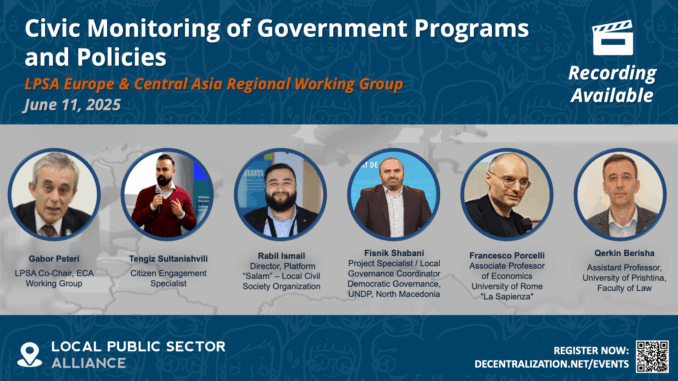
The LPSA Regional Working Group for Europe & Central Asia (ECA) held its Open Meeting on June 11, 2025, at 10:00 EDT / 15:00 BST / 16:00 CEST / 19:00 UZT. The meeting was opened by Mr. Gabor Peteri, LPSA ECA Co-Chair, and was moderated by Mr. Tengiz Sultanishvili, Citizen Engagement Specialist and newly appointed Co-Chair of the LPSA ECA Working Group. The meeting emphasized the growing importance of transparency, accountability and highlighted the crucial role of civic engagement and monitoring in strengthening democratic governance, ensuring that state programs align with public needs and priorities.
Mr. Rabil Ismail, Co-Founder & Board Member of Platform “Salam” – Local Civil Society Organization (Georgia), presented their civic initiative focused on enhancing local governance in ethnically diverse regions of Georgia. The organization monitors the implementation of the “State Rural Support Program” in four municipalities—Bolnisi, Dmanisi, Gardabani, and Marneuli, by observing village assemblies, reporting on participation and decision-making, and involving local youth in monitoring efforts.
The Salam Platform works to actively engage ethnic and religious minorities, youth, women, and persons with disabilities in local governance processes. Their activities include direct outreach to communities, bilingual social media campaigns in communities with Azeri minorities, surveys to identify local needs, and the submission of official recommendations to local authorities.
Mr. Ismail outlined several challenges, including low attendance at village assemblies, limited gender balance, lack of information sharing by local authorities, and widespread distrust in institutions. He criticized the dismissive attitude of some municipal leaders toward civil society organizations and stressed the need for more inclusive approaches.
His recommendations included the participation of mayors and city council chairs in community meetings, the publication of meeting schedules in minority languages, and allowing citizens to set priorities during assemblies instead of merely approving predetermined lists.
Mr. Fisnik Shabani, Project Specialist / Local Governance Coordinator, Democratic Governance, United Nations Development Programme (North Macedonia), praised the Salam Platform as a valuable tool for assessing local realities and providing actionable insights for improvement. He encouraged expanding the platform to more municipalities to enable comparative analysis and wider engagement. Mr. Shabani emphasized that bilingual communication, inclusive participation, and open feedback are key to building trust between citizens and local governments. He also highlighted the role of digital tools in ensuring transparent data collection and real-time reporting, which boosts scalability and accountability. Recognizing political challenges, he noted that some local governments may react defensively to citizen monitoring. Therefore, safeguards are needed to protect civic activists and institutionalize their participation. Mr. Shabani stressed the importance of tailoring approaches to local contexts and community needs. Reflecting on North Macedonia’s experience, he noted progress in citizen engagement driven by national laws and local initiatives despite past challenges in capacity and political will.
Responding on a question during the discussion Mr. Ismail admitted with disappointment that under the present legislation in Georgia no similar civic monitoring programs can be continued in the future.
Mr. Francesco Porcelli, Associate Professor of Economics, University of Rome “La Sapienza (Italy), introduced “OpenCivitas”, a pioneering initiative from Italy on how local government performance is measured and shared with the public. His presentation highlighted how this data-driven model supports greater transparency, civic engagement, and accountability in one of Europe’s most decentralized governance systems. Italy has over 8,000 municipalities responsible for key public services like social care, local police, and transportation.
Since 2009, the country has been transitioning from a historical cost-based grant allocation system to a more equitable, formula-based system. This reform calculates the fiscal gap, that is the difference between a municipality’s standard expenditure needs and fiscal capacity.
“OpenCivitas”, launched in 2014, is a web-based platform that presents fiscal and service performance data in a transparent and accessible way. It measures municipal performance through a dual-gap approach: the expenditure gap (historical vs. standard spending) and the output gap (historical vs. standard levels of service). Municipalities are plotted on a four-quadrant chart along two dimensions that allows the users to visually compare performance, identifying high and low performing local governments that spend more or less than the standard while delivering services.
Although designed for citizen use, OpenCivitas has proven especially valuable for researchers, journalists, and informed civil society actors. Service-specific evaluations are available for sectors such as waste management, general administration, local police, and road maintenance.
Mr. Porcelli emphasized that while open data can improve transparency and accountability, it is most effective when paired with a comprehensive and balanced performance assessment. Based on comparative assessment of municipalities in Lombardia he concluded that after a decade of implementation, OpenCivitas has successfully contributed to better service quality (e.g. waste recycling) and more efficient municipal spending.
Following Mr. Porcelli’s presentation, Mr. Fisnik Shabani shared his reflections on the OpenCivitas platform, highlighting its strong contribution to fiscal transparency, civic engagement, and public access to data in local governance. He praised the platform for effectively combining three key elements—transparency, fiscal monitoring, and user accessibility into a single, easy-to-use online tool. Mr. Shabani emphasized that giving citizens, researchers, and civil society organizations access to detailed municipal data across various sectors enables meaningful comparisons between municipalities. This transparency, he noted, can encourage local governments to improve their performance in areas where they may be falling behind or previously unaware of shortcomings. He also stressed the importance of presenting data and indicators in a clear and user-friendly way. For civic monitoring to truly work, platforms like OpenCivitas must be understandable not only by experts but by the general public as well. To conclude his remarks, Mr. Shabani raised a practical question about how the platform is kept up to date—specifically, who is responsible for entering and maintaining the data, and whether municipalities are required to share complete and consistent information, or if it is voluntary. Mr. Porcelli responded that the platform is managed by Italy’s Ministry of Economy and Finance, with support from private companies that process the data. Municipalities are required to complete standardized questionnaires as part of the fiscal equalization process. The data collected through this mandatory process is then reused to assess municipal performance, ensuring a consistent and structured flow of financial and structural information.
Mr. Qerkin Berisha, Assistant Professor at the University of Prishtina, Faculty of Law (Kosovo), gave a clear and compelling presentation on the evolving role of civil society in Kosovo’s policymaking and legislative processes. He emphasized that over the past decade, civil society organizations (CSOs) have become key actors in democratic governance, largely due to increased capacities supported by international donor funding following the 1999 conflict. While civil society engagement was initially stronger at the central level, its presence and impact at the local level have steadily grown.
Mr. Berisha explained that civil society in Kosovo uses a mix of institutional and informal tools to participate in policy-making. These include involvement in working groups during legislative drafting, the use of the “Konsultimet Publike” online platform, submission of legal opinions, comparative analyses, and advocacy reports. CSOs also engage through media campaigns, public roundtables, and memoranda of understanding (MoUs) with institutions to formalize their participation.
Mr. Berisha shared several positive examples where civil society has had a strong impact. In the case of the Law on Freedom of Association, civil society advocacy led to the president refusing to promulgate the law, sending it back to parliament for revision. Civil society also played a major role in shaping Kosovo’s system of public funding for NGOs, which is now regarded as transparent and accountable. Additionally, in drafting the Civil Code, government institutions actively involved civil society, especially on issues like property rights, inheritance, and family law, and incorporated many of their recommendations into the draft. However, several issues still hinder civil society’s effectiveness. Consultations are often launched late in the drafting process, giving civil society little time to provide meaningful input. Additionally, many government institutions fail to invite civil society into working groups or ignore their comments, often due to political reasons or predetermined policy directions.
Mr. Fisnik Shabani reflected on Mr. Berisha’s presentation, highlighting the positive growth of civil society organizations in Kosovo as key contributors to democratic governance. He emphasized their important role in bridging institutions and citizens, especially in policymaking and legislation. Mr. Shabani noted that the expanding number and quality of CSOs are a valuable national asset, enabling more targeted and effective action across diverse policy areas. He also pointed to challenges such as reliance on donor funding, gaps in expertise, and the need for sustainable, locally-owned approaches to CSO initiatives.
Mr. Gabor Peteri concluded the meeting, encouraged the EWG members’ networking in the coming period before the next open meeting of the regional Expert Working Group on Europe & Central Asia for November 12th, 2025.
A video of the meeting is available on YouTube. The links below provide access to the video segments of the different agenda items.
| Agenda Item | Contributor / Slides |
| 1. Welcome and Introduction | Gabor Peteri ECA Working Group Co-Chair Tengiz Sultanishvili Moderator/Citizen Engagement Specialist |
| 2. Participatory Monitoring of the State Rural Support Program in Georgia | Rabil Ismail Co-Founder & Board Member of Platform “Salam” – Local Civil Society Organization |
| 3. Discussant | Fisnik Shabani Project Specialist / Local Governance Coordinator Democratic Governance, United Nations Development Programme, North Macedonia |
| 4. Driving Transparency & Civic Engagement: The OpenCivitas Model from Italy | Francesco Porcelli Associate Professor of Economics, University of Rome “La Sapienza” |
| 5. Q&A & Discussant | Participants & Fisnik Shabani |
| 6. The Impact of Civil Society in Enhancing Policy-Making in Kosovo | Qerkin Berisha Assistant Professor, University of Prishtina, Faculty of Law |
| 7. Q&A & Discussant | Participants & Fisnik Shabani |
| 8. Closing Remarks & Next Steps | Gabor Peteri |
The next Europe & Central Asia webinar is scheduled for November 12th, 2025– Register Here!
Reminder: You can join any LPSA Expert Working Group free of cost and receive reminders and updates by opting-in to one or more working groups as part of your LPSA Membership registration.