
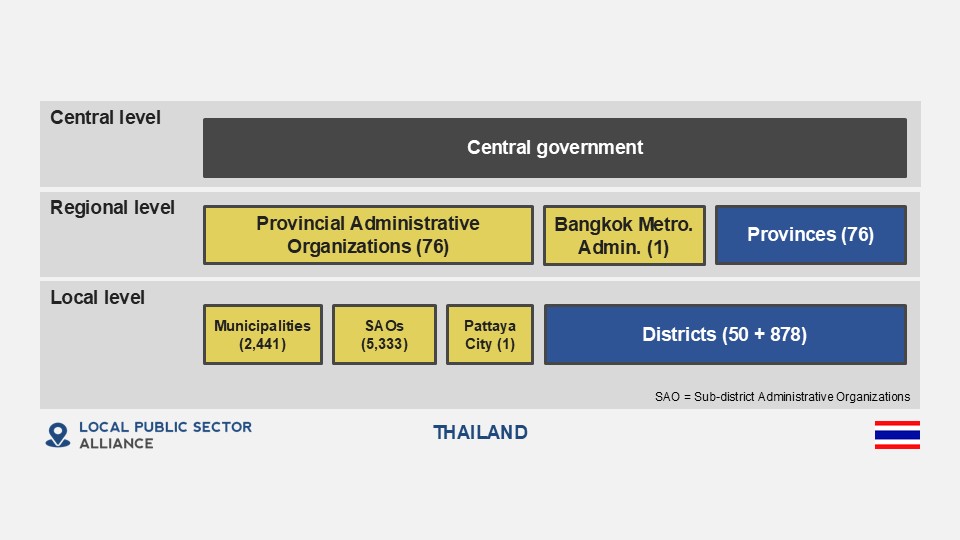
Thailand is a unitary state with a long tradition of centralized administration. Historically, public administration and service delivery have been organized through a deconcentrated territorial structure consisting of provinces and districts headed by centrally appointed officials under the Ministry of Interior. Provincial Governors and District Officers continue to serve as representatives of the national government and play an important role in coordinating national policies and public administration throughout the country. Beginning in the late 1990s, Thailand embarked on a major decentralization program following the adoption of the 1997 Constitution and the Decentralization Plan and Process Act of 1999. These reforms introduced the direct election of local executives and councils, expanded local service delivery responsibilities, and increased the fiscal resources available to local authorities.
Today, Thailand’s multilevel governance system consists of parallel systems of deconcentrated administration and elected local governance institutions. Alongside deconcentrated provincial and district offices of the central government, the country has more than 7,800 provincial and local governance units, including Provincial Administrative Organizations (PAOs), municipalities, Subdistrict Administrative Organizations (SAOs), the Bangkok Metropolitan Administration, and Pattaya City. These local governance institutions are responsible for a broad range of public services and are governed by directly elected local leaders. However, significant authority over personnel management, fiscal administration, borrowing, procurement, and regulatory oversight remains with the national government. As a result, Thailand’s local governance system is best characterized as a system of hybrid local governance operating alongside a strong deconcentrated territorial administration.
Subnational government structure
Thailand’s subnational governance system consists of two parallel structures: a deconcentrated territorial administration representing the national government, and a system of local governments exercising a degree of local self-government. The deconcentrated administration is organized into 76 provinces and more than 900 districts, headed by centrally appointed Provincial Governors (except Bangkok) and District Officers under the Ministry of Interior. Alongside this structure, Thailand’s local governance system consists of 76 Provincial Administrative Organizations (PAOs), 2,441 municipalities, 5,333 Subdistrict Administrative Organizations (SAOs), the Bangkok Metropolitan Administration (BMA), and Pattaya City.
These local governance institutions are governed by directly elected executives (BMA Governor, City Mayors, PAO and SAO chairmen) and directly elected councils. They are responsible for a broad range of local public services and development functions. While PAOs operate at the provincial level, they do not exercise authority over municipalities or SAOs in the manner of a regional government, and local governments generally function independently within their respective jurisdictions. As a result, Thailand’s subnational governance system is characterized by the coexistence of elected local governance institutions and a strong deconcentrated state administration, each performing distinct but often overlapping roles in local governance and service delivery.
Nature of subnational governance institutions
Beyond the parallel nature of deconcentrated systems and elected subnational organizations, a key feature of Thailand’s multilevel governance system is that even the elected provincial and local governance institutions combine important characteristics of devolved local government with significant elements of central government control. Provincial Administrative Organizations (PAOs), municipalities, Subdistrict Administrative Organizations (SAOs), the Bangkok Metropolitan Administration, and Pattaya City are all corporate bodies governed by directly elected executives and councils, possess their own budgets, and are responsible for a broad range of local public services and development functions. Citizens enjoy extensive local political rights, including the right to elect local officials, participate in local planning and budgeting processes, access local information, and hold local leaders accountable through various oversight mechanisms. However, important aspects of personnel management, financial administration, taxation, procurement, borrowing, and regulatory oversight are tightly governed by national laws and regulations and monitored by central government agencies, particularly the Ministry of Interior and Ministry of Finance. In addition, many local activities require prior approval from higher authorities or must conform to centrally prescribed procedures and spending frameworks. As a result, while Thailand’s elected provincial and local organizations possess meaningful political legitimacy and administrative responsibilities, they do not enjoy the full political, administrative, and fiscal autonomy typically associated with fully devolved local governments.
Functional assignments
The assignment of public sector functions in Thailand reflects the coexistence of a strong deconcentrated public administration alongside its system of elected provincial and local governance institutions. While the elected provincial and local governance institutions are responsible for a broad range of public services—including local infrastructure, environmental management, waste collection, local roads, parks and recreation, community development, disaster management, public markets, local economic development, and certain social welfare activities—many of the country’s most important public services remain largely planned, financed, managed, and delivered through central government ministries and their deconcentrated provincial and district administrations. In particular, public education remains primarily the responsibility of the Ministry of Education, while most public health services are administered through the Ministry of Public Health and its provincial and district networks. Similarly, major transport infrastructure, public security, agricultural extension, water resources management, and many regulatory functions largely continue to be managed through central government agencies. Although local governments contribute to these sectors and increasingly support local service delivery initiatives, they generally play a supplementary rather than a leading role in the provision of core public services.
LoGICA Assessment
LoGICA Intergovernmental Profile: Thailand 2026 (Excel)
Additional resources
Thailand Country Profile (World Observatory on Subnational Governance and Investment, OECD/UCLG)
Local government country profile: Thailand (UN Women)
Back to Local Public Sector Alliance Intergovernmental Profiles – Country Page
Last updated: June 17, 2026

