
Cambodia is a unitary parliamentary constitutional monarchy, with the ruling Cambodian People’s Party (CPP) dominating the political landscape as a de facto one-party state. Cambodia has pursued a gradual process of decentralization and deconcentration since the early 2000s. Although the Constitution recognizes multiple levels of subnational administration, the country’s governance system remains characterized by a strong central state and extensive deconcentrated administration through provincial and sectoral structures. Decentralization reforms began with the establishment of directly elected commune and sangkat councils in 2002. Cambodia’s 2008 Organic Law (formally known as the Law on Administrative Management of the Capital, Provinces, Municipalities, Districts, and Khans) is the foundational legal framework for the country’s Decentralization and Deconcentration (D&D) reforms, restructuring Cambodia’s subnational governance by introducing indirectly elected councils and unified administrations at the provincial and district levels. Successive National Programs for Sub-National Democratic Development have sought to strengthen local accountability, improve service delivery, and increase citizen participation, while maintaining the state’s unitary character. As a result, Cambodia’s intergovernmental system combines a powerful deconcentrated administrative apparatus with elements of democratic local governance.
Subnational governance structure
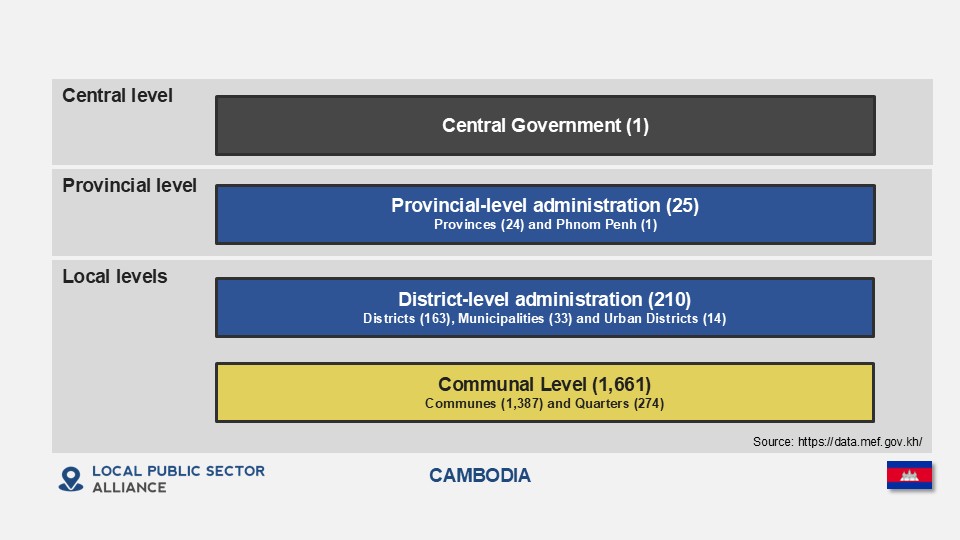
Cambodia’s subnational governance system consists of three territorial-administrative tiers below the national government. At the upper tier are 24 provinces (khaet) and the capital city of Phnom Penh, which enjoys provincial status. Below the provincial level are (rural) districts (srok), municipalities (krong), and urban districts within Phnom Penh (khans). At the lower local tier are communes (khum) in rural areas and sangkats in urban areas. Together, Cambodia has more than 1,600 commune and sangkat jurisdictions, with directly elected Commune Chiefs and local councils.
While the formal governance structure appears hierarchical, the practical organization of public administration is more complex, with deconcentrated provincial departments of central ministries operating alongside centrally appointed subnational executives and indirectly elected provincial and district councils. Provincial administrations serve as the principal territorial coordinating level for central government policies and public services, while district and municipal administrations are gradually assuming expanded responsibilities under ongoing decentralization reforms.
Nature of subnational governance institutions
Subnational governance institutions in Cambodia have a mixed character. Although the Organic Law formally recognizes provincial and district-level administrations as autonomous subnational institutions, in practice, these entities remain closely integrated with the central administrative hierarchy and rely heavily on central government funding, personnel, and policy direction. Provincial, municipal, district, and khan councils are indirectly elected by lower-level councilors; these councils function primarily as representative bodies overseeing executive administrations headed by governors appointed by the central government. Consequently, Cambodia’s provincial and district administrations are best understood as non-devolved (deconcentrated) administrative institutions that combine extensive deconcentrated administrative authority with some elements of local political representation.
Closest to the people, commune and sangkat councils are directly elected by local residents and represent the most established form of local democratic governance in the country. While communes and sangkats exhibit somewhat greater decision-making autonomy in local affairs compared to higher-level administrative tiers, they possess more limited administrative and service delivery capacities.
Functional assignments
The assignment of public functions in Cambodia remains highly centralized despite ongoing functional transfers to subnational administrations.
Most core public services—including education, health care, agriculture, social protection, and major infrastructure—continue to be delivered primarily through provincial and district offices of central ministries. Provincial administrations play an important coordinating role and are responsible for local planning, administration, regulatory functions, and selected development activities. District, municipality, and khan administrations have gradually received additional responsibilities, including certain administrative services, local infrastructure management, environmental functions, and citizen-facing services through One Window Service Offices and related reforms. Commune and sangkat administrations focus primarily on local development planning, small-scale infrastructure, community services, civil registration support, and citizen engagement.
While successive decentralization programs have expanded the role of subnational administrations, the transfer of functions, personnel, and financing has proceeded incrementally, leaving Cambodia’s public service delivery system predominantly deconcentrated in practice, with local governance institutions playing a complementary rather than leading role in most major service sectors.
LoGICA Assessments
LoGICA Intergovernmental Profile: Cambodia 2026 (Excel)
Additional resources
Cambodia Country Profile (World Observatory on Subnational Governance and Investment, OECD/UCLG)
Local government country profile: Cambodia (UN Women)
Cambodia Intergovernmental Fiscal Architecture Study, World Bank, 2021.
Voluntary Subnational Review Cambodia, National League of Local Councils (NLC), May 2023
Snapshot of Sustainable Development Goals at the Subnational Administration Level in Cambodia. Asian Development Bank, July 2024
Back to Local Public Sector Alliance Intergovernmental Profiles – Country Page
Last updated: June 19, 2026

