
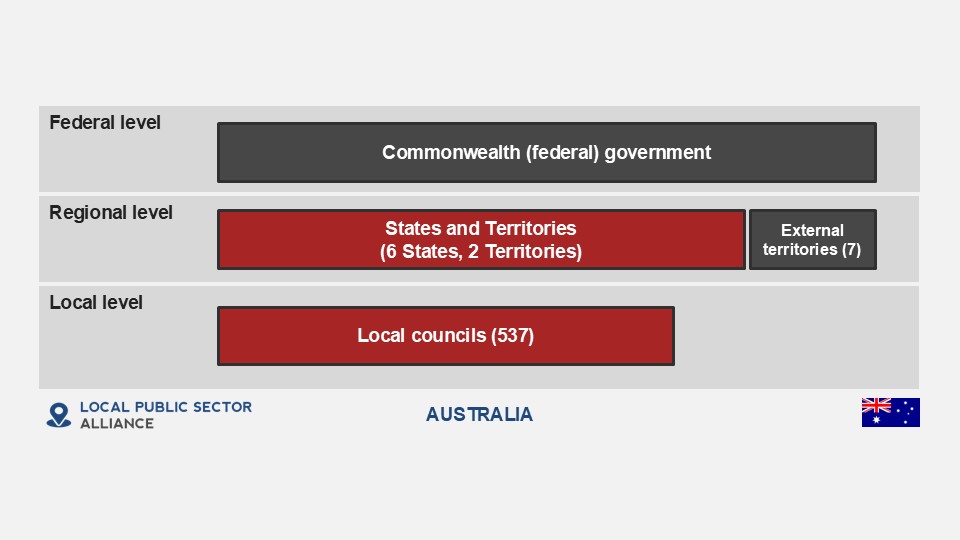
Australia is a federal parliamentary democracy and constitutional monarchy composed of three spheres of government: the Commonwealth (federal) government, six states, two self-governing territories, and 537 local governments. The Australian Constitution establishes a federal system in which legislative powers are divided between the Commonwealth and the states, while residual powers remain with the states. Since Federation in 1901, Australia has evolved into one of the world’s most decentralized federal systems in constitutional terms, although fiscal relations are characterized by a significant degree of vertical fiscal imbalance, with the Commonwealth government raising a larger share of public revenues than it directly spends. Intergovernmental relations are shaped by extensive cooperation and coordination among governments through a range of formal and informal mechanisms, including National Cabinet and intergovernmental agreements. Australia’s multilevel governance system combines constitutionally protected state governments with a strong tradition of local self-government operating under state legislation.
Subnational governance structure
Australia’s subnational governance system consists of two principal levels below the federal government. The regional level comprises six states—New South Wales, Victoria, Queensland, Western Australia, South Australia, and Tasmania—as well as the self-governing territories of the Australian Capital Territory and the Northern Territory. These jurisdictions possess their own constitutions, elected legislatures, executives, and judicial systems, and exercise substantial legislative and administrative authority across a wide range of policy areas. In addition, Australia administers seven external territories located in the Indian Ocean, the Pacific Ocean, and Antarctica. These offshore dependencies are directly managed by the Australian federal government.
Below the state and territory level are 537 local governments, generally organized as cities, municipalities, shires, regional councils, or districts. The different titles are primarily historical, demographic, or geographic classifications rather than reflecting differences in their legal status. Unlike the states, local governments are not recognized in the Australian Constitution and derive their authority entirely from state and territory legislation.
With a few structural exceptions, Australia operates with a single-tier system of local government. The two exceptions include New South Wales, which utilizes county councils in some regions (special-purpose authorities formed by two or more LGAs) to manage specific regional issues (like weed management, flood mitigation, or water supply); and Unincorporated Areas: Vast, sparsely populated regions in the Northern Territory, South Australia, and all of the Australian Capital Territory (ACT), which do not have LGAs. In these areas, state or territory governments directly administer services.
Nature of subnational governance institutions
Australia’s states and territories are full-fledged regional (state) governments possessing constitutionally or statutorily protected legislative, executive, and administrative authority. State governments are elected through direct elections and exercise broad autonomy in the management of public affairs within their jurisdictions.
Local governments are also governed by directly elected councils and enjoy a significant degree of administrative and political discretion in local matters; however, they remain legally subordinate to state and territory governments, which retain the authority to establish, modify, amalgamate, or abolish local governments. As a result, Australia combines a strong federal system at the regional level with a comparatively robust system of local self-government that, despite lacking constitutional recognition at the federal level, plays an important role in community governance, local infrastructure, planning, and service delivery. Although the degree of local autonomy varies across states and territories according to the respective local government legislation and intergovernmental arrangements, the institutional nature of local governments is consistently fully devolved.
Functional assignments
The assignment of public functions in Australia reflects the country’s federal structure. The Commonwealth government is primarily responsible for national and international matters, including defense, foreign affairs, immigration, trade, macroeconomic policy, social security, and national taxation.
State and territory governments are responsible for most major public services, including public education, hospitals and health services, policing, justice, public transport, land administration, environmental regulation, and regional infrastructure. Local governments perform a range of local functions delegated under state legislation, including local roads, waste management, community facilities, local planning and development control, environmental health, recreation services, libraries, and various regulatory functions.
While constitutional responsibilities are divided among the three spheres, many policy sectors involve shared responsibilities and co-financing arrangements, particularly in health, education, infrastructure, housing, environmental management, and social services. Consequently, effective governance in Australia depends heavily on intergovernmental coordination and fiscal transfers between levels of government.
LoGICA Assessments
LoGICA Intergovernmental Profile: Australia 2026 (Excel)
Additional resources
Three levels of government: governing Australia; The responsibilities of the three levels of government (Parliamentary Education Office, Australia)
Australia Country Profile (World Observatory on Subnational Governance and Investment, OECD/UCLG)
The Local Government System in Australia. Commonwealth Local Government Forum
Local government country profile: Australia (UN Women)
Back to Local Public Sector Alliance Intergovernmental Profiles – Country Page
Last updated: June 22, 2026

