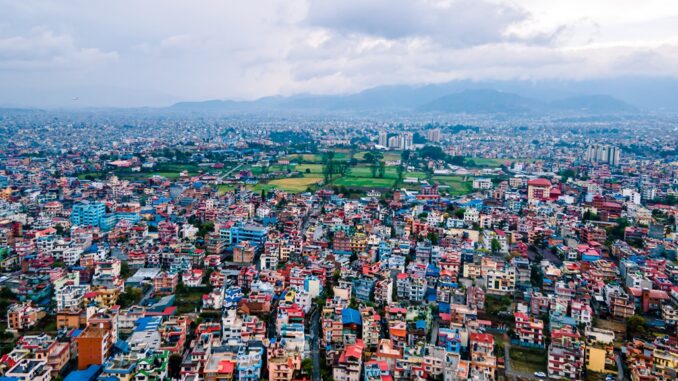
Nearly a decade after adopting its federal constitution, Nepal has made significant progress in bringing government closer to citizens. The country’s transition from a unitary state to a federal democratic republic under its 2015 Constitution represents one of South Asia’s most ambitious decentralization reforms. With seven provinces and 753 local governments, the country has fundamentally restructured its system of governance, seeking to bring public decision-making closer to citizens, strengthen democratic representation, and promote more inclusive development.
The recently released Nepal: The State of Federalism Report 2025, developed by the Government of Nepal through the Provincial and Local Governance Strengthening Programme (PLGSP), with technical support from UNDP, provides a comprehensive assessment of this transformation.
The report offers an important message: Nepal’s federal system has become firmly established, but significant gaps remain between the constitutional assignment of powers and the actual ability of provincial and local governments to exercise them.
Political federalism: An important institutional achievement
Perhaps the most significant achievement of Nepal’s federal transition has been the establishment of democratically elected governments across all three tiers. Provincial and local institutions are now functioning throughout the country, supported by an expanding body of legislation and governance systems.
The report finds that approximately 74 percent of the federal legislation needed to implement the Constitution has been enacted. Nepal has also made substantial progress in political inclusion. Women hold approximately 41 percent of elected local government positions and 36 percent of provincial assembly seats, reflecting constitutional provisions designed to broaden political participation.
However, important shortcomings remain. Women account for only 13 percent of mayors and local government chairs, illustrating the difference between representation and leadership. Key legislation governing the civil service, education, and health sectors also remains incomplete, limiting the effective exercise of constitutionally assigned responsibilities.
Intergovernmental coordination presents another challenge. Although mechanisms for cooperation between federal, provincial, and local governments have been established, they meet irregularly, and implementation of their decisions remains inconsistent.
Fiscal federalism: Continued dependence on central transfers
Fiscal decentralization has advanced considerably, particularly through the establishment of formula-based intergovernmental fiscal transfers and digital public financial management systems. These reforms have improved the predictability and transparency of subnational financing. Nevertheless, the report identifies substantial fiscal dependence as a continuing weakness. Provincial and local governments remain heavily reliant on federal transfers, while their ability to mobilize own-source revenues is limited.
Although intergovernmental transfers are an essential component of any well-functioning federal system, the limited fiscal discretion available to subnational governments can constrain their ability to respond to local priorities, and raises important questions about the alignment of expenditure responsibilities, revenue authority, and accountability.
The report therefore calls for strengthening revenue mobilization, improving fiscal equalization, and expanding the role of unconditional transfers. These reforms would help ensure that provincial and local governments have not only the resources to fulfill their mandates, but also sufficient discretion to allocate those resources in response to citizens’ needs.
Administrative federalism: The missing link
Perhaps the clearest implementation gap concerns administrative decentralization.
Although Nepal has established provincial and local administrative structures, these institutions continue to face significant staffing and capacity constraints. According to the report, only 38 percent of approved provincial civil service positions have been filled.
The absence of a fully operational federal civil service framework, together with persistent difficulties in recruitment, deployment, and personnel management, has complicated the transition toward effective subnational administration.
These challenges illustrate a broader lesson from international decentralization experience: assigning functions and financial resources to subnational governments is insufficient unless those governments also possess the administrative authority, personnel, and institutional capacity needed to deliver services.
The report recommends strengthening provincial public service commissions, professionalizing subnational administration, and establishing clearer arrangements for personnel management across government tiers.
Citizens place greater trust in local government
One of the report’s most interesting findings concerns how citizens perceive the federal transition. Drawing on the 2025 Survey of the Nepali People, the report finds that public confidence in the country’s overall direction has declined sharply. Only 23.7 percent of respondents believe Nepal is moving in the right direction, compared with 65.6 percent in 2020. Yet confidence in local governance remains comparatively strong. Approximately 68.6 percent of respondents express trust in municipalities and rural municipalities, while 75.9 percent trust ward institutions. Trust in provincial governments stands at 45.5 percent.
These findings suggest that citizens distinguish between their broader dissatisfaction with national political and economic conditions and their experiences with government services closer to home. Indeed, improvements in roads, drinking water, health services, and electricity are among the most frequently cited reasons for positive assessments of local conditions.
At the same time, the report identifies weaknesses in participatory governance. Although public hearings are widely conducted, citizen feedback is not consistently incorporated into government planning and decision-making. Strengthening local accountability will therefore require moving beyond formal participation mechanisms toward more meaningful responsiveness.
From establishing federalism to making it work
The report’s overarching recommendation is that Nepal should now shift its attention from establishing federal institutions to improving their performance. This will require completing the legal framework for federalism, clarifying functional responsibilities, strengthening intergovernmental coordination, improving fiscal autonomy, and addressing persistent administrative capacity gaps. Particular attention is needed to the role of provincial governments, whose coordinating and service delivery functions remain underdeveloped relative to their constitutional position within the federal system.
Importantly, the State of Federalism Report 2025 also establishes a baseline for monitoring future progress, with follow-up assessments planned for 2027 and 2029. This creates an opportunity to move beyond debates about the merits of federalism in principle toward an evidence-based assessment of how effectively the system serves citizens.
Nepal’s experience offers a broader lesson for countries pursuing decentralization and multilevel governance reforms. Establishing elected subnational institutions is an important milestone, but effective decentralization requires the political, fiscal, and administrative dimensions of governance to advance together. After a decade of constitutional and institutional transformation, the central question for Nepal is no longer whether federalism has taken root. It is whether the different levels of government will be given the authority, resources, capacity, and accountability mechanisms needed to deliver on its promise.
Read the full report : Provincial and Local Governance Strengthening Programme (2025). Nepal: The State of Federalism Report 2025. Government of Nepal, with technical support from UNDP.