Kenya’s 2010 devolved constitution established county governments as the primary level of government responsible for the provision of childcare facilities, assigning them a mandate that is both critical and, until devolution, largely undefined. Despite considerable interest among county governments to support the childcare sector, most counties lack a dedicated department, program, or systematic approach to providing, regulating, or supporting childcare services, resulting in limited registration, oversight, and public support for safe, affordable, and quality childcare.
The provision of childcare services in Kenya is essential for children’s early development and is a major driver of gender equity, as unpaid care work is a core barrier to women’s economic empowerment.
A recent analysis of county childcare practices prepared as part of the Localizing Women’s Economic Empowerment in Africa (LWEEA) Project found that actual investment in childcare by counties remains exceptionally low. Most county governments allocate minimal or no direct funding to support childcare for children under four, with budget lines for childcare either absent or subsumed under broader early childhood programs. This lack of focused county spending severely limits the expansion, quality, and regulation of childcare services, leaving the sector underfunded despite its constitutional mandate and critical role in women’s economic participation.
These findings raised a pressing need for greater clarity regarding county governments’ ability and mandate to fund and support childcare services. With this in mind, the Local Public Sector Alliance. prepared the study County Funding for Childcare in Kenya: How Much Fiscal Space Is There for County Childcare Spending?
The document addresses recurring questions from policymakers, advocates, and development practitioners: What is the fiscal space available at the county level for childcare spending? What are the funding mechanisms available, and how can counties prioritize and structure their investments to meet the constitutional mandate on childcare while advancing women’s economic empowerment? The note is intended to inform decision-makers and stakeholders by unpacking the myth surrounding limited county resources and providing a framework for understanding the fiscal capacity to support childcare as a devolved function in Kenya.
This document analyzes the fiscal space available to counties for childcare, clarifying that while “there is no money” is a common refrain, county governments do have access to financial resources through three main streams: the national government’s equitable revenue sharing (the largest source), potential conditional grants, and county own-source revenues. Until 2025, the equitable sharing process, which constitutes at least 15 percent of national revenue, was governed by a formula that indirectly allocated resources for childcare under the “other county services” category, weighted at 18 per cent of the total allocation. Analysis shows that for the 2024/25 fiscal year, KShs. 7.39 billion is notionally available across all 47 counties for childcare services, representing an indicative allocation of KShs. 1,562.76 per child aged 0-3.
Importantly, these funds are not provided as conditional grants but as part of an unconditional pool, and actual county expenditure on childcare remains well below this potential, largely due to competing priorities, limited political responsiveness, and a lack of clarity on county governments’ roles in childcare. The principal bottleneck to county childcare spending, therefore, is not the unavailability of funds but the prioritization and identification of high-impact county-level childcare interventions that deliver value-for-money.
The paper calls for greater clarity, coordination, and systems change involving all levels of government, civil society, and development partners, stressing that a multilevel, inclusive childcare ecosystem will take time to develop.
The document dispels the misconception that lack of funding is the primary obstacle, highlighting instead the need for systemic change, incentives for formalization, and platforms for collective action to unlock the full potential of public and community investment in Kenya’s childcare sector.
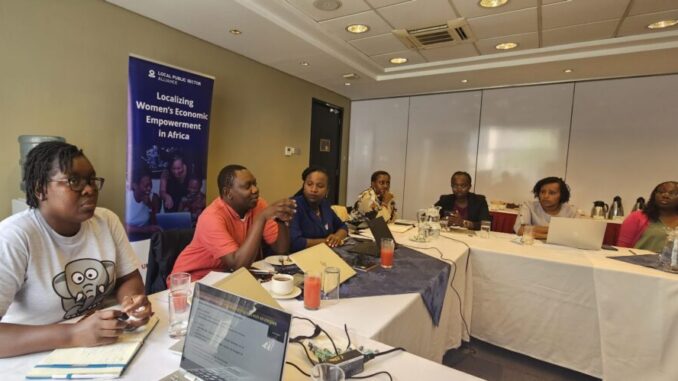
The preparation of the document was guided by the Technical Working Group on Localizing Women’s Economic Empowerment and Childcare in Kenya. The Technical Working Group of the Localizing WEE in Africa Project is comprised of a cross-sectoral array of actors, including Wowmom Kenya, Tiny Totos, Kidogo Early Years, Nurture First, WIEGO, Community Initiative Agenda, SOS Children’s Villages Kenya, Uthabiti Africa, the Collaborative Action for Childcare, Council of Governors, the National Gender and Equality Commission, CREAW Kenya, Intergovernmental Relations Technical Committee, ICRW, and Strathmore University. Together, these organizations are working towards a common goal-the formalization and improvement of the childcare sector in Kenya.
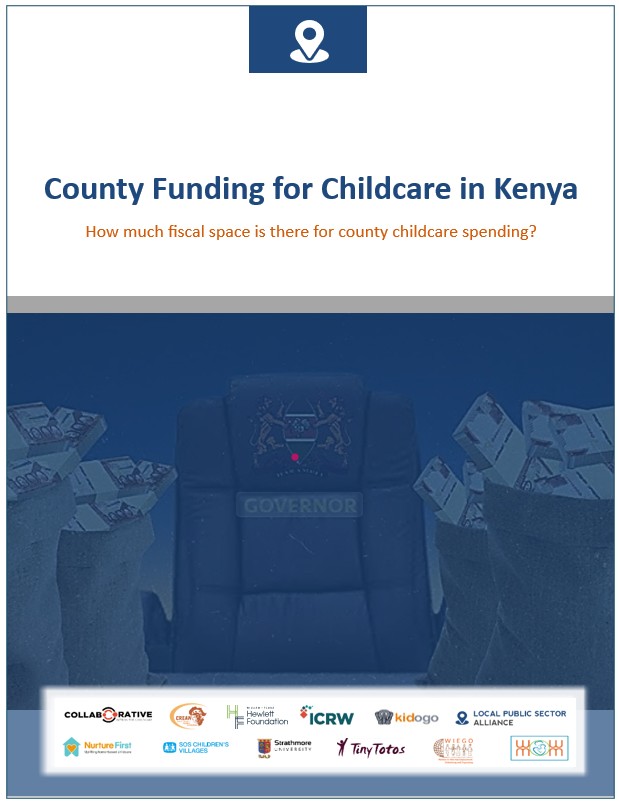
The full report is publicly available:
Local Public Sector Alliance. 2025. County Funding for Childcare in Kenya: How Much Fiscal Space Is There for County Childcare Spending? Nairobi, Kenya.