
The OECD report Implementing Regional Development Strategies: A Practitioner’s Guide (2025), authored by Jeroen Michels and Yingyin Wu of the OECD Centre for Entrepreneurship, SMEs, Regions and Cities (CFE), offers timely guidance on one of the most persistent challenges in public policy: turning long-term regional development visions into tangible results. Drawing on lessons from OECD member countries, regions, and municipalities, the report sets out twelve interconnected practices to bridge the gap between strategy design and effective delivery.
For practitioners, the report is especially relevant because it recognizes that implementation is not linear. Strategies evolve in complex, multi-level governance systems shaped by shifting political priorities, diverse stakeholders, and resource constraints. Rather than prescribing a one-size-fits-all blueprint, the OECD provides a flexible, adaptive framework rooted in practical experience.
Why Implementation Matters
Regional development strategies aim to address pressing global and local challenges, demographic shifts, climate change, digitalization, and industrial transitions through place-based approaches. While governments often devote substantial energy to designing such strategies, implementation tends to be the weaker link. Political cycles, changing funding streams, and institutional fragmentation often undermine execution, leaving strategies underdelivered or abandoned mid-way.
The OECD report makes a compelling case that the credibility of regional policy depends on closing this delivery gap. Without effective implementation, strategies risk becoming symbolic documents rather than drivers of long-term change.
The OECD Framework: Three Dimensions, Twelve Practices
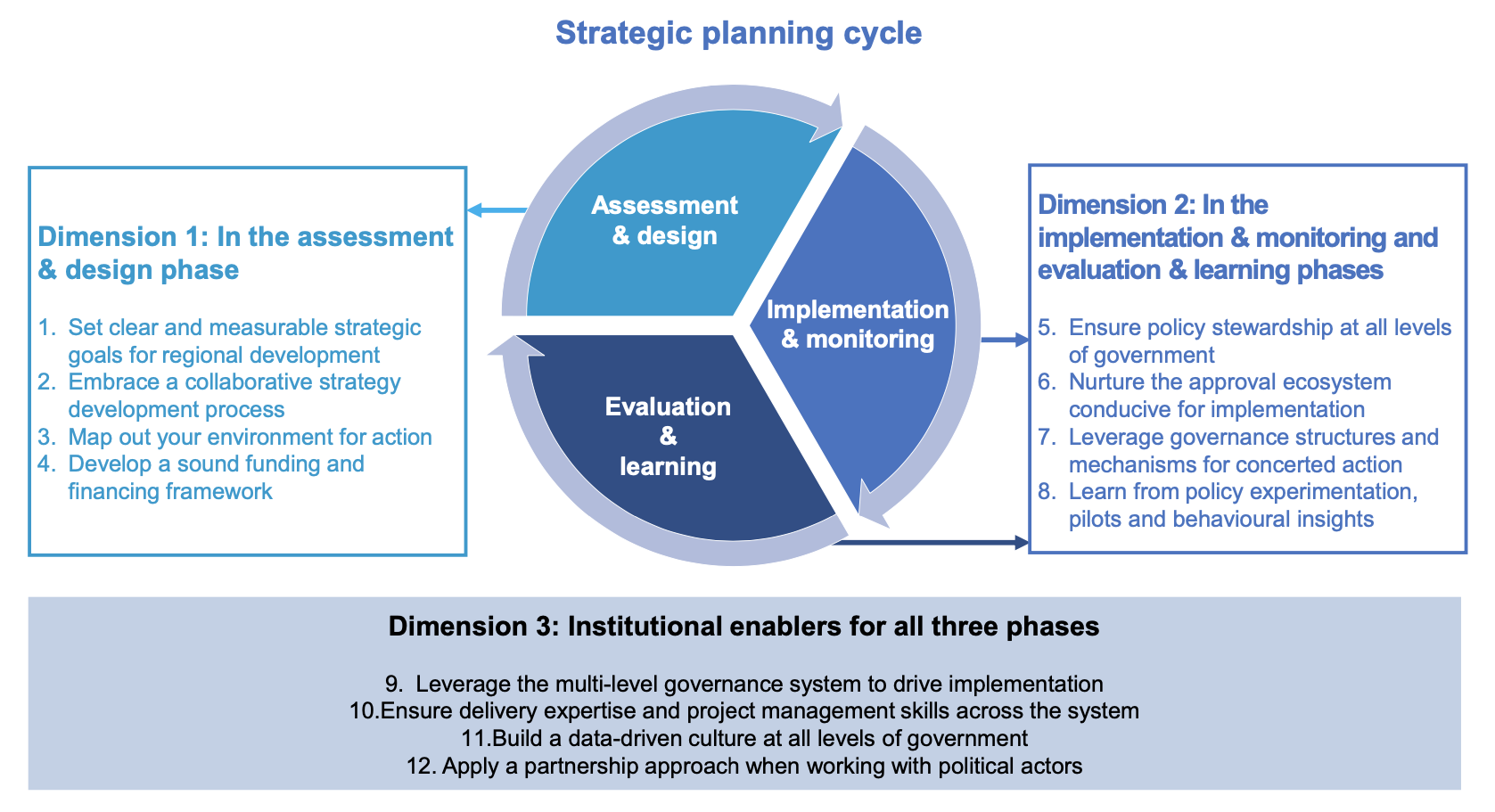
Figure: Implementing regional development strategies: Dimensions and practices throughout the strategic planning cycle. Created by the authors. (OECD, 2025).
At the heart of the report is a set of 12 practices, grouped into three dimensions of the strategic planning cycle:
- Assessment & Design Phase
- Set clear, measurable goals.
- Embrace a collaborative development process.
- Map the environment for action (political, institutional, financial).
- Establish sound funding and financing frameworks.
- Implementation, Monitoring & Learning Phase
- Ensure policy stewardship across government levels.
- Build an “approval ecosystem” that supports action rather than delays it.
- Leverage governance structures for concerted action.
- Use experimentation, pilots, and behavioral insights to adapt policies.
- Institutional Enablers Across All Phases
- Strengthen multi-level governance systems.
- Build delivery expertise and project management capacity.
- Foster a data-driven culture at all government levels.
- Engage political actors through partnerships, not confrontation.
Each practice is supplemented with guiding questions and real-world country examples, compiled in a checklist for policymakers.
Beyond diagnosing problems, the report also offers practical instruments.
A. Capacity assessments help governments gauge institutional readiness and identify skills gaps before launching strategies.
B. Political economy analysis (PEA) sheds light on incentives, interests, and power dynamics that shape policy outcomes.
C. Implementation risk assessments allow policymakers to anticipate disruptions and build contingency plans.
These tools encourage governments to take a proactive, foresight-driven approach rather than reacting to crises once strategies falter.
The Role of Multi-Level Governance
One of the strongest messages is that effective regional development depends on multi-level governance systems that can coordinate across national, regional, and local levels while incorporating non-governmental stakeholders. Joint decision-making bodies, regular reporting, and cross-level accountability mechanisms help insulate strategies from short-term political shifts and ensure long-term focus.
As governments confront overlapping transitions, from climate adaptation to digitalisation, the risks of implementation failure are high. Without deliberate efforts to strengthen delivery, even the most ambitious regional strategies risk becoming stalled documents.
Conclusion
The OECD’s Implementing Regional Development Strategies: A Practitioner’s Guide is more than a technical manual; it is a call to take implementation as seriously as design. By embedding foresight, fostering collaboration, and strengthening governance capacities, regional strategies can be translated into measurable improvements for communities.
The guide combines practical tools, checklists, and real-world examples that support decision-making and delivery across different contexts. Most importantly, it underscores the need to insulate strategies from short-term cycles and ensure continuity in execution, providing a framework for policymakers to translate strategies into actionable steps across diverse contexts
You can access the full report here: Michels, J. and Y. Wu (2025), “Implementing regional development strategies: A practitioner’s guide”, OECD Regional Development Papers, No. 162, OECD Publishing, Paris, https://doi.org/10.1787/ae8b0b0e-en.
Note: The Feature Image for this blog is AI generated.