The global development community is going through a sea-change, with many global development champions and civil society organizations facing a system-wide decline in official development funding. Numerous members of the Local Public Sector Alliance (LPSA) have been directly impacted by the defunding of development, while others are trying to adjust to how global development will be pursued and funded in the future.
Given the sudden change in the global development context, LPSA is at an inflection point. Its long-term ability to serve its growing member base, and pursue its mission—which is now more important than ever—will depend in large part on the Alliance’s ability to strategically support its members by engaging in knowledge development; knowledge sharing; and convening, outreach, and field-building.
Global development happens in the cities, towns and communities where people live and work
Perhaps a silver lining of the current crisis in global development is that many development practitioners will increasingly see ‘development’ in the way that many of us within LPSA already understand it, based on the recognition that development happens in the cities, towns and communities where people live and work, rather than in the halls of global development agencies in the Global North.
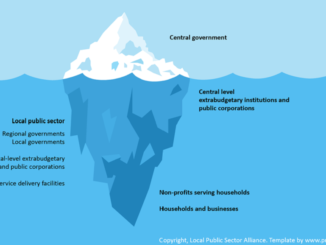
Even at its peak, official development assistance accounted only for a tiny fraction—ranging roughly from 1-6 percent—of ‘development funding’. In reality, the principal funders of development efforts in the Global South are the tax-paying households and businesses in the Global South that fund their central, regional, and local governments in pursuit of better public services and development.
In the emerging—potentially more agile—global development community, rather than relying on project interventions with external funding lifelines, many global development actors will have to leverage existing public sector systems in pursuit of their objectives and will have to forge collaborative partnerships with national, regional, and local government institutions to ensure localized development results.
Multilevel public sectors as the primary mechanism for inclusive and sustainable development
With global development institutions in retreat, it becomes more obvious to many that the public sector is unambiguously the primary enabler of global development—capable of propelling development forward by promoting inclusive and effective multilevel governance systems—and equally capable of bringing progress to a halt if it doesn’t.
Countries all over the world—in the Global North and Global South alike—thus face a critical policy choice: national leaders can position the public sector to serve the interests of the powerful few, or they can position their public sector as a platform for inclusive development, where governance institutions—at the national level, as well as at the regional and local levels—serve as mechanisms for responsive public service provision and as engines of social transformation and sustainable development.
Successful localized development requires ensuring that countries deliver public services and pursue development through inclusive and sustainable multilevel governance systems. Indeed, inclusive and efficient multilevel governance systems can—and should—be leveraged to contribute to global security, economic prosperity, and human development in countries around the world.
What is LPSA’s unique contribution to the process of promoting inclusive governance, localized public services, and sustainable development?
Many OECD countries have adopted multilevel governance systems where regional and local governments are empowered —politically, administratively, and fiscally—and capable of meaningfully advancing the collective interests of their constituents. As a rule, this is currently not the case in other global regions, especially not in many countries in Sub-Saharan Africa, Asia, and the MENA region.
In these countries, efforts to decentralize or to ‘localize development’ cannot succeed by merely engaging local government officials and building local capacity in support of local development ambitions. Instead, in these countries, unleashing the power of multilevel governance will require empowering local institutions to meaningfully contribute to the delivery of public services and support development in policy areas where they have a comparative advantage, in a way that is most suitable for their specific context.
In other words: the benefits from decentralization and localization can only be unlocked by an inclusive and efficient multilevel governance system. As many LPSA members know firsthand, however, shifting the power—from the central public sector to the local public sector—is not an easy task, as few central government institutions are willing to let go of powers and resources, even when local government actors are potentially well-positioned to deliver services or pursue development in a more efficient and responsive manner.

It is this insight—that decentralization is not to be pursued for decentralization’s sake, but that decentralization is a critical public sector reform with important technical as well as political economy aspects—that drives LPSA to pursue its ambitions to elevate the decentralization debate with the ultimate objective of ensuring that public sectors are able to leverage inclusive and effective multilevel governance systems as a means to achieving inclusive and sustainable development.
Towards LPSA’s strategic priorities: 2026-2030
The overarching ambition of the Alliance in the coming years should be not only to serve as a convening place for advocates for decentralization and multilevel governance, but to leverage the knowledge and experiences of its global network to support efforts to improve the inclusiveness and responsiveness of their public sector though multilevel governance reforms, thereby shifting LPSA’s ambitions from merely ‘elevating the debate on decentralization and localization’ to the added ambition of ‘catalyzing action’.
A summary of LPSA’s emerging strategic priorities for the coming years can best be organized by the geographic level at which the Alliance’s proposed interventions are to be targeted: at the global, regional, and country level.
As a global professional network, LPSA’s organizational and programmatic structure provides a strong foundation for its efforts going forward. However, given the likely need of the Community of Practice to “do more with less”, the determination of which strategic priorities will ultimately be implementable may come down to the availability of funding.
Global focus: Ensuring global coordination and supporting global development actors refocus their role in development
At the global level, LPSA’s primary priority over the coming period is to ensure the basic organizational continuity and operation of the Alliance itself as it diversifies its funding support. In addition to serving as a global professional network for its members, LPSA is uniquely positioned to bring together a range of leading global decentralization institutions to ensure coordination, prevent duplication, and elevate the debate among decentralization stakeholders in a rapidly shrinking funding environment. The Alliance should further pursue knowledge development at the intersection of multilevel governance and adjacent practice communities (e.g., health, gender, public finance management, and so on).
Global MLG interventions (Proposed Strategic Priorities)G1 Ensure LPSA’s ability to act as a global expert network on decentralization and MLG G2 Convening global decentralization champions and experts G3A Global thematic knowledge development: Inclusive and responsive multilevel public sector management (localizing services and development) G3B Global thematic knowledge development: Elevating the debate and catalyzing action on Gender-Responsive MLG G3C Global thematic knowledge development: Pursue other global-level thematic interventions G4 Engage in global knowledge sharing (at global region and country level) |
Regional-level focus: Development and sharing knowledge on decentralization and multilevel governance
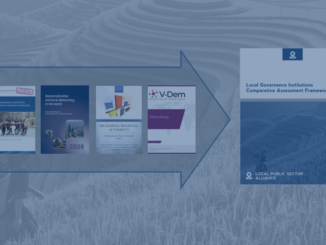
LPSA’s knowledge development and knowledge sharing efforts have shown that there is considerable global variation in countries’ experiences with decentralization and multilevel governance, both across and within different global regions. Whereas the nature of local governance institutions varies considerably across countries, the lack of consistent terminology and critical data and knowledge gaps within and across global regions often hinders evidence-informed policy dialogues on the state of decentralization and multilevel governance.
LPSA’s should aim to leverage the knowledge and experiences of its global network to promote the consistent use of terminology and to ensure the availability of comparative data and information on decentralization and multilevel governance within each global region—as a mechanism for elevating the debate and catalyzing action. Through its regional working groups, the Alliance should bring together global, regional, and country-level decentralization stakeholders and thought leaders within different global regions to engage in regional knowledge development and knowledge sharing on decentralization and multilevel governance.
Regional MLG interventions (Proposed Strategic Priorities)R1 Promote decentralization and localization of development in Sub-Saharan Africa R2 Promote decentralization and localization of development in Asia R3 Promote decentralization and localization of development in Europe and Central Asia (ECA) R4 Promote decentralization and localization of development in the MENA Region R5 Promote decentralization and localization of development in other global regions (LAC, OECD) |
Country-level focus: Promoting development by empowering evidence-based, inclusive and responsive multilevel governance system
Inclusive public sectors typically emerge when broad coalitions mobilize to demand representation and accountability, whereas autocracies often arise when political and economic elites consolidate power to protect their interests, especially in times of instability or external threat. Ultimately, however, the choices made by national government leaders and policymakers determine the extent to which their public sectors will function as mechanisms for central (or local) elite capture, or whether the public sector is structured to act as an inclusive and responsive mechanism for collective decision-making and collective action that responds to the needs of the people.
Potential country-level interventions by the Alliance should include supporting and guiding government leaders and country-level stakeholders in decentralizing countries (or countries poised to pursue greater decentralization or more effective multilevel governance system) to find consensus and adopt more inclusive and responsive multilevel governance systems. LPSA should also leverage its knowledge and expertise to pursue country-level interventions in newly decentralized countries (e.g., Kenya) to support more inclusive and responsive multilevel governance systems (either across the board, or in selected specific sectors).
Country-level MLG interventions (Proposed Strategic Priorities)C1 Support Kenya’s Devolution Process – Assessment of County Government Performance C2 Fragile country-level interventions C3 Other country-level interventions |
Draft for Discussion: The evolving global context for multilevel governance and global development. Towards defining LPSA’s strategic priorities for 2026-2030. (Draft: July 2025)