
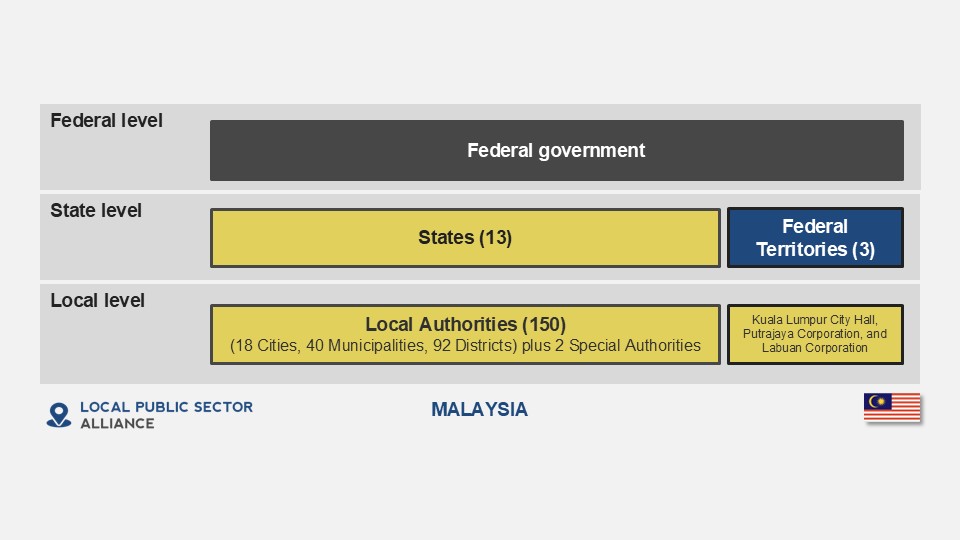
Malaysia is a federal constitutional monarchy comprising 13 states and three Federal Territories. The Federal Constitution divides legislative and executive responsibilities between the federal and state governments, although Malaysia operates as a relatively centralized federation in administrative and fiscal terms. State governments have constitutionally recognized authority over matters including land, local government, Islamic affairs and aspects of natural resource management, while the federal government is responsible for most major public services and national functions. Each state has its own executive government and elected State Legislative Assembly, although administrative arrangements vary considerably across states, including in the extent to which state administrations rely on federal public service personnel. Sabah and Sarawak have distinctive constitutional and administrative arrangements and enjoy greater autonomy in a number of areas.
Subnational governance structure
Malaysia’s subnational governance structure comprises a regional level of 13 states and a local level of local authorities (Pihak Berkuasa Tempatan, or PBT). The three Federal Territories—Kuala Lumpur, Putrajaya and Labuan—are administered under federal rather than state authority and therefore constitute exceptions to the regular state structure. At the local level, Malaysia currently has 151 local authorities, comprising 19 city councils or city halls, 40 municipal councils and 92 district councils; several additional statutory bodies perform local-authority functions in designated areas. Local government arrangements are not completely uniform across the country: Peninsular Malaysian local authorities are principally governed under the Local Government Act 1976, while Sabah and Sarawak operate under their respective local government ordinances. Alongside these local authorities, district administration offices (such as District and Land Offices) and sub-districts (Mukim) form important elements of Malaysia’s territorial and administrative organization, operating under the administrative control of the respective state governments.
Nature of subnational governance institutions
Both states and local authorities should be understood as hybrid subnational governance institutions, although they occupy quite different positions within this category. States are closer to devolved subnational governments with limited autonomy: they have elected legislative assemblies, executive governments, constitutionally assigned powers, separate budgets and revenues, and authoritative decision-making powers within their assigned areas, but their autonomy is constrained by limited functional responsibilities and significant federal influence (and therefore, lack of state autonomy) over state administrative systems and personnel. Indeed, personnel arrangements differ across states, with some states exercising greater control over their own civil services than others. Local authorities, by contrast, are hybrid institutions that are closer to non-devolved institutions. They are corporate bodies with their own administrative apparatus, staff, budgets, revenues and substantial municipal responsibilities, but they operate under considerable state government control. Local political leadership is appointed rather than elected, while personnel and other important administrative decisions remain subject to state government control, approval and oversight.
Functional assignments
Malaysia’s federal government is responsible for most major national and social-sector functions, including defense, internal security, education, health, finance, commerce and other matters assigned to the Federal List. States exercise responsibility in areas including land, local government, Islamic affairs and aspects of natural resource management, alongside responsibilities shared with the federal government. Local authorities perform primarily municipal and regulatory functions, including local planning and development control, roads and public spaces, drainage, environmental health, licensing, markets, waste-related functions and other local services. The precise assignment of local responsibilities varies across Peninsular Malaysia, Sabah and Sarawak and according to the type and capacity of local authority; federal agencies also play important roles in functions that elsewhere may be performed predominantly by local governments.
LoGICA Assessments
LoGICA Intergovernmental Profile: Malaysia 2026 (Excel)
Additional resources
Government of Malaysia, MyGovernment Portal — official information on Malaysia’s state government structure, state executive councils, legislative assemblies, state administration and public services.
Department of Local Government, Local Authority Statistics — official current count and classification of Malaysian local authorities. Department of Local Government: JKT & PBT Statistics
UN Women, Women in Local Government – Malaysia Country Profile
OECD/UCLG World Observatory on Subnational Government Finance and Investment (SNG-WOFI) – Malaysia Country Profile
Commonwealth Local Government Forum (CLGF), The Local Government System in Malaysia
Back to Local Public Sector Alliance Intergovernmental Profiles – Country Page
Last updated: September 28, 2026

