As democratic institutions worldwide grapple with declining trust, growing polarization, and the pressures of misinformation, a recent OECD Discussion Paper —Exploring New Frontiers of Citizen Participation in the Policy Cycle –offers a timely framework for rethinking how citizens engage with public decision-making.
Developed for the 2024 OECD Global Forum on Building Trust and Reinforcing Democracy in Milan, and building on the findings of the 2024 OECD Trust Survey, the discussion paper provides an analytical framework and a call to action for governments and civil society to embed meaningful, accountable citizen participation into the heart of the policy cycle.
The analyses and survey results confirm something that is already widely accepted within the decentralization community of practice, but contested by others: it is important to bring the public sector closer to the people. Bad news for national politicians: the available evidence indicates that trust in local government generally exceeds trust in the national and regional governments.
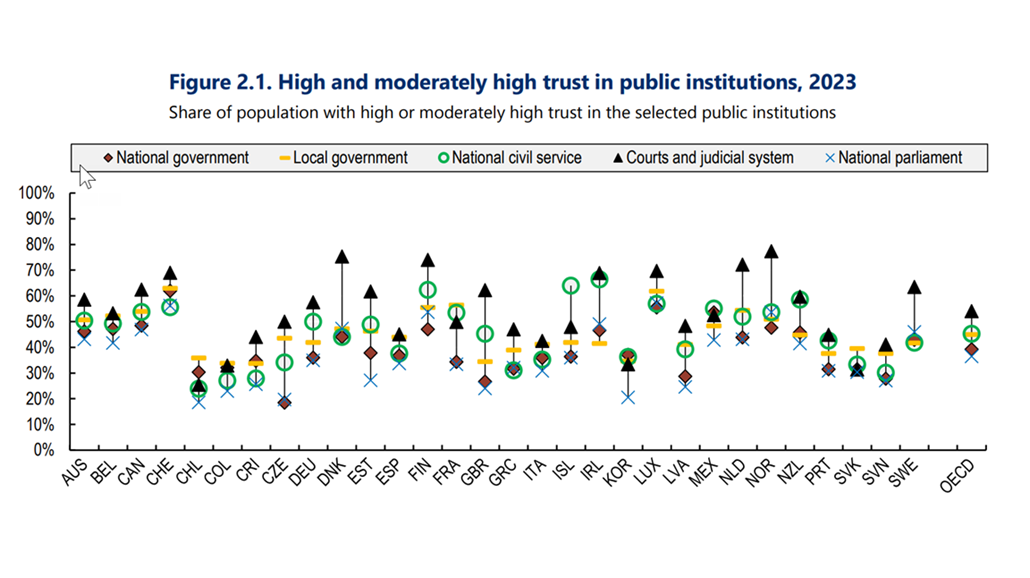
The central message of the analysis is clear: inclusive multilevel governance and citizen participation are no longer optional—it is a core function of effective and resilient governance.
The Democratic Deficit: A Crisis of Trust and Representation
The 2024 OECD Trust Survey reveals that across 30 OECD countries, 44% of citizens express low or no trust in their national governments, while 53% believe that the political system does not allow people like them to have a say. This means that among the roughly 600 million adults across the 30 OECD countries surveyed, nearly 320 million people feel they have little or no influence over political decisions.
Although citizens benefit from efficient public services, they remain skeptical of governments’ ability to manage long-term challenges such as climate change, digital transformation, and demographic shifts. The survey data show that only:
- 37% believe governments will act fairly across generations,
- 42% have confidence in achieving net-zero emissions goals, and
- 41% trust that governments will regulate new technologies, such as artificial intelligence and digital applications.
This is not merely a perception gap—it reflects a structural imbalance between governance capacity and citizen agency. As citizens become more informed and interconnected, their expectations for fairness, accountability, and voice continue to rise.
Addressing Systemic Challenges to Citizen Participation
Many governments have launched participatory initiatives—consultations, open data platforms, digital forums—but too often, these remain symbolic or short-lived. The OECD calls for a systemic shift: from ad hoc engagement to co-creation, where participation informs not only policy design but also implementation, monitoring, and accountability.
The paper highlights four interlinked systemic challenges:
- Developing a shared understanding of meaningful citizen participation. While the OECD has long promoted inclusive definitions and frameworks- recognizing participation as both a right and a tool to improve policy outcomes, many governments still treat it as optional rather than integral to policy making. The 2024 OECD Trust Survey shows that citizens’ expectations for genuine engagement remain unmet, highlighting the gap between aspiration and practice. To move forward, public institutions must recognize that there is no “one-size-fits-all” approach—participation must reflect social and cultural diversity, draw on behavioural insights, and evolve through continuous dialogue about its purpose, scope, and impact.
- Coordination of citizen participation among public institutions within and across levels of governance. The growing number of participatory initiatives across governments has created both opportunities and challenges for coordination. Citizens often face a fragmented landscape of consultations, assemblies, and engagement tools, leading to confusion and “participation fatigue”. Effective coordination—both horizontally among ministries and vertically across subnational, national, and international levels—is essential to build a coherent citizen participation ecosystem. Applying the subsidiarity principle and creating strong “transmission belts” to connect participation outcomes across levels of governance can make engagement more transparent, impactful, and accountable.
- Aligning the “front office” and the “back office” of public institutions. Modern governments have made great strides in improving their “front office” — the public-facing side that enables access to information, consultations, and participatory processes. Yet, these efforts often remain disconnected from the “back office,” where crucial administrative functions (public financial management and accounting, preparation of regulatory impact assessments, drafting of legislation and decrees, procurement, infrastructure planning, provision of in-service training, performance management and audit) shape what is realistically possible. This misalignment limits the real impact of citizen participation and weakens trust. Achieving meaningful participation requires linking open, responsive front-office initiatives with transparent and accountable back-office systems.
- Ensuring accountability for citizen participation throughout the policy cycle. Accountability is essential to ensure that citizens’ contributions meaningfully influence public policy. Too often, citizen input is gathered but not visibly reflected in outcomes, eroding trust in participatory processes. Governments should clearly communicate the purpose, scope, and limits of engagement at each stage of the policy cycle, and provide transparent feedback through mechanisms such as public participation logs. This includes explaining how citizen input was used—or why it was not—while documenting constraints such as legal, fiscal, or technical limitations. Embedding such accountability practices strengthens democratic legitimacy and ensures participation delivers tangible impact.
Democracy’s Climate Test: Empowering Citizens for a Just Transition to Net Zero
The global transition to Net Zero by 2050 is more than a technical challenge—it is a defining test of whether democratic systems can rise to meet long-term, multi-level, and cross-sectoral crises with fairness, resilience, and inclusion. The OECD makes a compelling case: embedding citizen participation in climate policy is not merely desirable—it is essential. Without it, legitimacy falters, implementation stalls, and trust erodes. With it, we unlock the full potential of democratic governance to drive transformative change.
Integrating citizen voices across climate policy processes can lead to:
- Promotes transparency and fairness in how the costs and benefits of the green transition are distributed;
- Enhances public acceptance of adaptation and mitigation measures, making policies more resilient;
- Strengthens collective responsibility for ecological outcomes, turning passive concern into active stewardship; and
- Builds trust in both domestic and international climate governance, reinforcing the social contract in a time of global uncertainty.
In practice, this requires institutionalizing citizens’ assemblies on climate, participatory budgeting for green investments, and local consultative forums linking municipalities, civil society, and businesses.
The Maturity Model: Embedding Citizen Participation as the Life Force of Democratic Renewal
Democracies worldwide face rising public expectations, growing scepticism, and complex global challenges — from digital disruption and disinformation to the climate crisis. Against this backdrop, the OECD argues that putting citizens at the heart of the policy cycle is essential for rebuilding trust and reinforcing democratic resilience.
After decades of experimentation, countries now need a maturity model for citizen participation — one that integrates all branches of government, spans every phase of the policy cycle, and guides institutions in embedding inclusive and accountable practices. A strategic approach means moving beyond ad-hoc consultations toward a whole-of-state “citizen participation ecosystem”, aligning executive, legislative, judicial, and oversight bodies in fostering meaningful engagement.
To translate this strategy into practice, the OECD recommends the following steps for governments:
- Adopt a Citizen-Centred Perspective: Review all existing participation avenues by focusing on the citizen’s experience within the policy cycle, ensuring avenues are accessible and relevant.
- Encompass a “Whole-of-State” Approach: Strategically examine how all institutions (executive, legislature, judiciary, and oversight bodies like Ombuds offices) function together to create an integrated participation ecosystem.
- Learn from Data and Evidence: Utilize findings from research, such as the biennial OECD Trust Survey and lessons from work on deliberative policy-making, to inform strategy. This includes incorporating insights from key areas like climate change, multilevel governance, education and skills.
- Go Beyond Diagnostics to Action: Conduct a strategic and functional review of current citizen participation systems by focusing on objectives, activities and the capabilities required to achieve them (beyond the choice of specific institutional designs or tools, which will vary across countries and levels of governance).
- Reinforce Evaluation and Measurement: Increase efforts to evaluate and measure the actual outcomes and impact of citizen participation, moving beyond only assessing the quality and inclusivity of the process itself.
A Call to Action for Democratic Renewal from the Local Level Up
Democratic renewal cannot succeed through national reforms alone—it must take root locally, where citizens most directly experience public services and governance outcomes. Local governments are on the frontlines of trust-building, delivering essential services, managing resources, and engaging citizens in tangible decisions about their communities.
For subnational actors, the OECD’s framework offers an opportunity to institutionalize citizen participation as a permanent feature of local governance—from participatory budgeting and citizen assemblies to open contracting and social accountability mechanisms.
Local governments, supported by central authorities and development partners, can:
- Integrate participatory processes into budget preparation, infrastructure planning, and service delivery;
- Strengthen local transparency systems, ensuring that participation data and outcomes are published and used for accountability;
- Foster collaboration among municipal councils, civil society, and local media to bridge the gap between citizens and decision-makers; and
- Embed citizen participation into multi-level governance frameworks, ensuring that local voices inform national and global policymaking.
Reinforcing democracy begins at the community level—where trust is built, accountability is tested, and citizens experience the real value of inclusion. As the paper reminds us, citizens are not only the beneficiaries of governance—they are its co-authors. Empowering them locally is the surest path toward a more re.silient, participatory, and legitimate democracy.
Read the full OECD Discussion Paper here:
Exploring New Frontiers of Citizen Participation in the Policy Cycle (OECD, 2024)
OECD Survey on Drivers of Trust in Public Institutions – 2024 Results
Note: The Feature Image for this blog post is AI generated.